Implant Surgery & Support
Preventing and treating peri-implantitis
A bacterial infection that destroys the bone and tissue surrounding an integrated implant — and one of the few implant problems that is almost entirely preventable.
How it starts
Peri-implantitis typically begins as peri-implant mucositis — inflammation of the soft tissue alone, with no bone involvement yet. At this stage it is fully reversible.
Untreated, it progresses to bone destruction, and bone lost around an implant does not come back on its own. Because the process often develops without pain, professional monitoring is what catches it while it is still the reversible kind.
Five ways to prevent it
Oral Hygiene
Daily brushing and implant-specific flossing or interdental brushes to stop plaque accumulating at the implant-gum junction.
Regular Maintenance Visits
Professional cleanings every six months, which also give us the probing depths and imaging that detect trouble early.
Smoking Cessation
Quitting reduces infection risk substantially and improves bone healing. This is the single largest modifiable risk factor for most patients who smoke.
Systemic Disease Management
Controlling conditions such as diabetes, coordinated with your physician, because glycaemic control directly affects healing and infection risk.
Surgical Precision
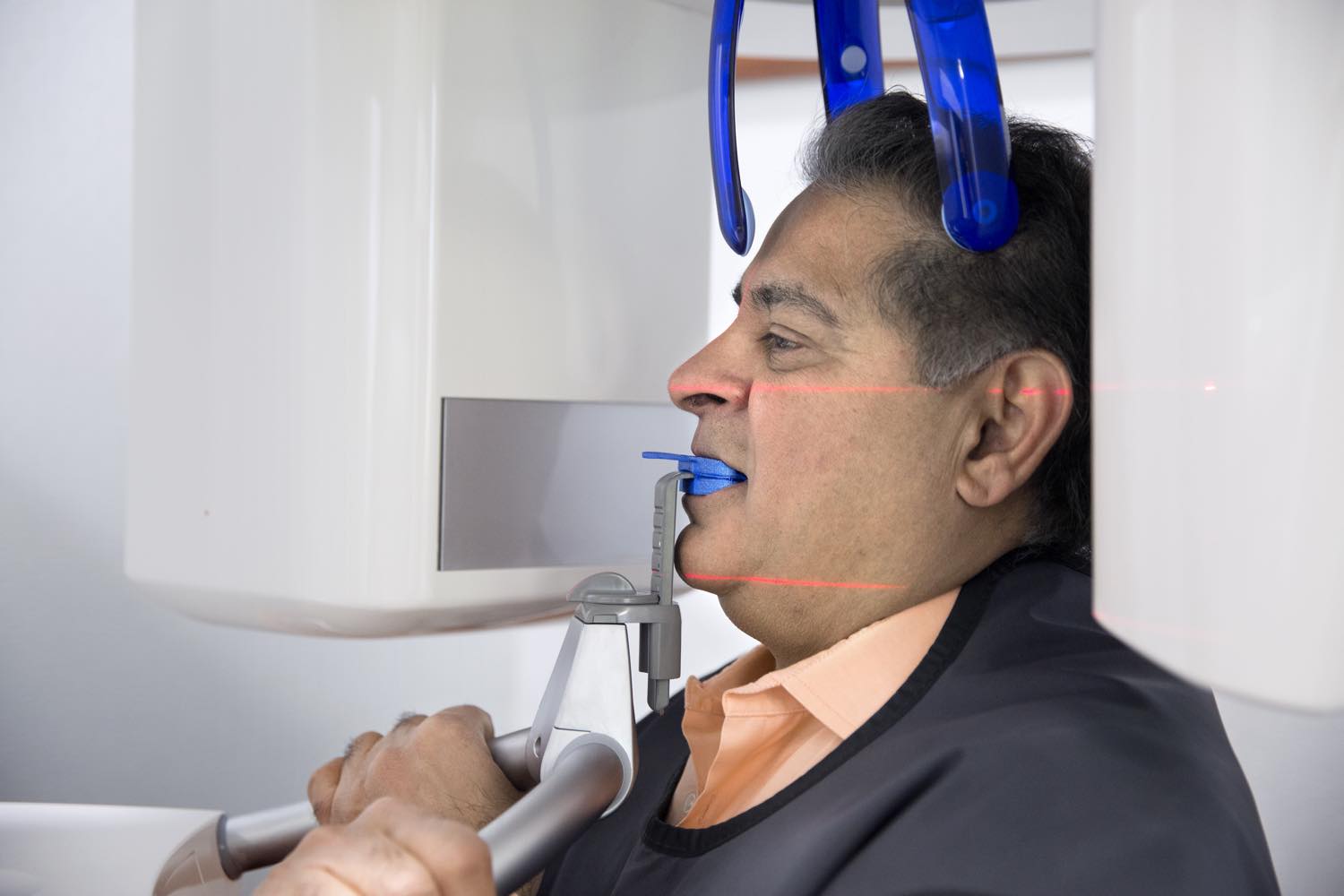
Optimal implant placement using CBCT imaging and computer-guided surgery, so the implant sits in adequate bone with a restoration that can actually be cleaned.
Treatment, stage by stage
Early-stage disease responds well to mechanical debridement — cleaning the implant surface — combined with antimicrobial therapy.
Advanced cases may require surgical intervention to access and decontaminate the implant surface, together with bone grafting to rebuild what has been lost. Many implants are saved with timely treatment.
Where bone loss is extensive, removal and replacement after a healing period may be the only reliable option. That outcome is almost always the end of a process that had visible warning signs months earlier.
Why an implant cannot be cleaned like a tooth
This is the part that surprises people, and it shapes everything about how peri-implant problems are treated.
A tooth root is mineralised tissue. A steel curette scrapes deposits off it and leaves a smooth surface behind, which is exactly what you want. An implant is titanium, and often a deliberately roughened titanium — the surface texture is what let bone grow onto it in the first place. Run steel across it and you score it. A scored surface holds more plaque than the one it replaced, so the instrument meant to fix the problem has made the site harder to keep clean for the rest of its life.
So the toolkit is different:
- Titanium or plastic instruments — softer than, or matched to, the implant surface, so deposits come off without scoring it.
- Air-polishing with fine glycine or erythritol powder — reaches into threads and irregularities that no hand instrument can follow, without cutting the surface.
- Titanium brushes — used in surgical access, where the surface can be seen and reached directly.
- Lasers — decontaminate the pocket and the surface without mechanical contact at all, which is the point of them here.
None of these is a magic answer, and all of them work better when the restoration allows a brush to reach the area in the first place. A crown contoured so that nothing can be cleaned under it is a design problem, not a hygiene problem, and it is dealt with differently.
Where the laser fits
A laser can decontaminate the sulcus and the implant surface without touching either, which is why it has a role here that it does not really have around natural teeth.
The published evidence supports it for inflammation. A 2025 systematic review pooling fifteen randomised trials across 658 implants found Er:YAG laser reduced bleeding on probing by 35.6% and pocket depth by 0.65 mm, and that mechanical debridement combined with an Er,Cr:YSGG laser reduced bleeding by 47.3% and pocket depth by 1.23 mm. The American Academy of Periodontology's review of the field found a 21% greater reduction in bleeding when a laser was added to non-surgical treatment.
What none of those reviews found was an effect on bone loss around the implant, or clear superiority over careful mechanical debridement on its own. And in surgical treatment specifically, adding an Er:YAG laser has not been shown to improve pocket depth. We would rather set that out than let the good numbers stand on their own.
We do not want aggressive instrumentation anywhere near an implant surface, and that is the reason the laser matters here more than it does on natural teeth. Being able to decontaminate the sulcus or the pocket around an implant without touching the titanium is genuinely useful. In my experience there is a real benefit in holding back inflammation and stopping early peri-implant problems from getting worse.
The stage it is caught at matters more than the instrument. Peri-implant mucositis — inflammation of the gum around an implant with no bone lost yet — can usually be resolved. Peri-implantitis — the same inflammation once bone has started to go — can be halted, but the bone that has gone does not come back. That is the same arithmetic as gum disease around natural teeth, and it is the argument for the maintenance appointments that follow implant treatment as much as they follow gum treatment.
Common questions
Why can't my hygienist just scale my implant like a tooth?+
Because a steel scaler scratches titanium, and a scratched implant surface holds more plaque than it did before. Implants are cleaned with titanium or plastic instruments, air-polishing with fine powder, and lasers. It is not that your implant is fragile — it is that the surface texture is what holds it in bone, and damaging it works against you.
Does a laser treat peri-implantitis on its own?+
No, and nobody has shown that it does. It is used alongside cleaning, not instead of it. What the pooled trials do show is a consistent effect on inflammation — bleeding around the implant falls substantially when a laser is added. They do not show an effect on bone loss.
What is the difference between peri-implant mucositis and peri-implantitis?+
Bone. Mucositis is inflammation of the gum around an implant with no bone loss, and it is usually reversible. Peri-implantitis is the same inflammation once bone has begun to go, and while it can be stopped, the bone already lost does not return. Catching it at the mucositis stage is the whole game.
I had gum disease before my implants. Am I more at risk?+
Yes. A history of periodontitis is one of the clearest risk factors for peri-implantitis, along with smoking and plaque control. It does not mean implants are a bad idea for you — it means the maintenance schedule afterwards is not optional.
Related procedures & comparisons
Questions about your procedure?
Prevention is far easier than treatment once peri-implantitis takes hold. Book your maintenance review on (905) 479-7777.