
For Patients
Dental implant financing
Understanding what treatment costs should be as clear as understanding the treatment itself. Here is how payment actually works.
Your payment options
Third-Party Financing
We partner with financing companies offering flexible monthly payment plans for qualifying patients, with terms built around your budget rather than a fixed schedule.
Insurance Coverage
We coordinate with your dental insurance to maximise benefits, particularly on the restoration phase, submitting claims electronically and verifying coverage before treatment begins.
CDCP & Government Programs
We coordinate the Canadian Dental Care Plan and employer-sponsored benefits to reduce your out-of-pocket cost, and handle the administrative side ourselves.
Every charge itemised
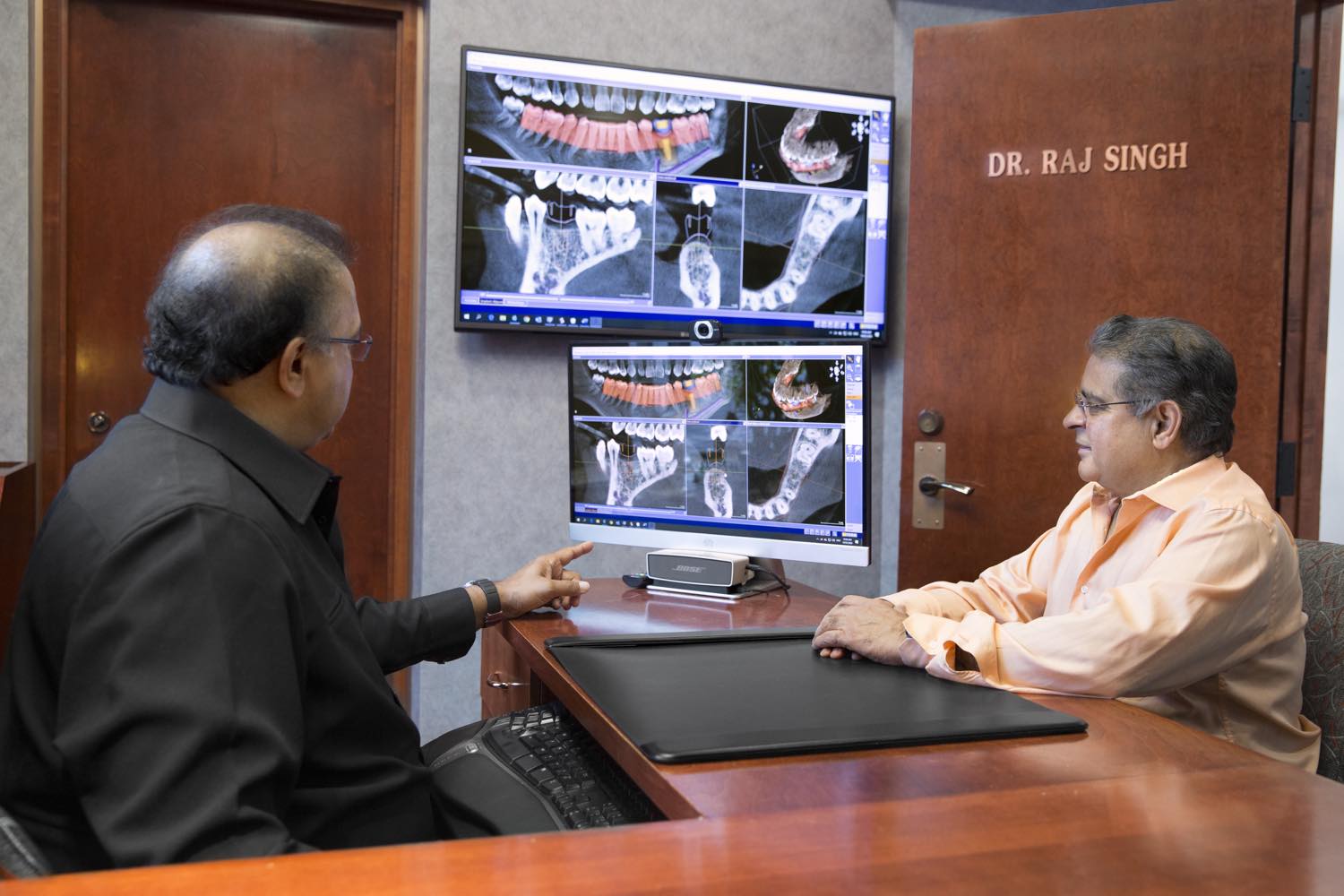
Your estimate breaks out each component: 3D CBCT imaging, computer-guided surgical planning, the implant components themselves, sedation if applicable, and the custom restoration.
There are no hidden fees. If something is not on the estimate, it is not going to appear on the invoice.
The long-term arithmetic
An implant costs more upfront than a bridge or a denture. Over time, that can reverse.
A single implant runs $3,500 to $6,000 and is designed and planned to be long-lasting. A bridge costs $1,500 to $3,000 initially but generally needs replacing every seven to fifteen years — so over the years you may pay for it more than once, plus the cost of whatever the failing bridge did to the teeth supporting it.
We will run this comparison for your specific case rather than in the abstract, because sometimes the shorter-term option genuinely is the right answer.
What it costs, before anything about paying for it
No page about paying for treatment is useful without the figures, so here they are. These are our ranges in Markham, all-inclusive from the planning scan through to the final restoration. Fees vary between patients because the work does, and you get a written itemised estimate before anything begins.
| Treatment | Typical range |
|---|---|
| Single implant, all in | $3,500 – $6,000 |
| Implant bridge on two implants | $7,000 – $12,000 |
| Removable overdenture on 2–4 implants | $12,000 – $18,000 |
| All-on-4, per arch | $18,000 – $25,000 |
| All-on-6, per arch | $24,000 – $36,000 |
| Bone graft, simple | $1,500 – $3,000 |
| Sinus lift or complex graft | $3,500 – $5,500 |
More detail on what moves a figure within those ranges is on what dental implants cost.
Why insurance covers implants badly
This is the part worth understanding before you start, because it is where the expectations usually break.
Private plans that cover implants at all treat them as major restorative work, which means about 50% — against an annual maximum usually between $1,500 and $2,500. Do the arithmetic on a $5,000 implant: 50% is $2,500, but the maximum caps the payment at $2,000, and that is before anything else you might need that year. Some plans cover the crown but not the implant beneath it. Some carry a waiting period. Some exclude implants outright.
And the CDCP does not cover implants at all. It is a good plan for everyday care and it is explicit that implants, bridges and orthodontics are outside it. More at the CDCP and dental implants.
None of which means do not check. It means check first, in writing. We send a predetermination to your insurer before implant treatment so you have their answer rather than an estimate of it — see how dental insurance works.
The part that is often covered
Even where the implant itself is excluded, the work around it frequently is not. Extractions, bone grafting where it is a clinical prerequisite, and the crown on top are each handled under different categories, and plans treat them differently. Itemising the estimate is not just for transparency — it is what lets each component be submitted under the heading most likely to be paid.
Ways to pay for it
- Interest-free plans on treatment over $1,200, spreading the balance with no interest applied. Subject to approval.
- Extended terms of up to sixty months for larger plans such as full-arch treatment, through a third-party lender. Rates and terms are theirs, and disclosed before you commit.
- Third-party financing, including Medicard, with the application handled here.
- Insurance plus financing — coverage applied first, the remainder spread.
- Phased treatment where it is clinically sound. Extract and graft this year, place and restore next, so the cost and two annual maximums both fall differently.
What you always get first is the written estimate, itemised — the imaging, the surgical planning, the implant components, sedation if you are having it, and the restoration, each on its own line. If a figure is not on the estimate it will not appear on the invoice.
Cost over time
An implant costs more at the outset than a bridge or a denture. Over a long enough horizon that usually reverses, and it is worth seeing the reasoning rather than being told the conclusion.
A single implant is $3,500 to $6,000 and is designed and planned to be long-lasting. A bridge is $1,500 to $3,000 and generally needs replacing every seven to fifteen years — so over the years you may pay for it more than once, plus whatever the failing bridge did to the two teeth carrying it, which were healthy when this started.
The honest caveat: that comparison assumes the implant does well, and not every one does. It also ignores the cases where a bridge is simply the better clinical answer — where the neighbouring teeth already need crowns, or where there is not enough bone and you would rather not have a graft. We will run the comparison for your situation rather than in the abstract, and sometimes the shorter-term option genuinely is the right one. See implants compared with bridges and implants compared with dentures.
Common questions
Does insurance cover dental implants?+
Sometimes, partly. Private plans that cover them treat implants as major restorative work at around 50%, against an annual maximum usually between $1,500 and $2,500 — so on a $5,000 implant the payment is often capped near $2,000. Some plans cover the crown but not the implant. The Canadian Dental Care Plan does not cover implants at all. We send a predetermination before treatment so you have the insurer's answer in writing first.
What does a single dental implant cost here?+
$3,500 to $6,000, all in — that figure covers the planning scan, the implant, the abutment and the final crown. Where a tooth has to come out first, or bone grafting is needed, those are separate and itemised. You get the full written figure before anything starts.
Do you offer payment plans?+
Yes. Interest-free plans on treatment over $1,200, extended terms up to sixty months for larger treatment through a third-party lender, and partnerships including Medicard. All are subject to approval, and the terms are disclosed before you commit to anything.
Can I spread implant treatment across two years to use two insurance maximums?+
Often, yes, and we will suggest it where it is clinically sound — an extraction and graft in one benefit year, placement and restoration in the next. Where waiting would cost you bone or make the result worse, we will say so instead, because saving a few hundred dollars by losing a graft site is not a saving.
Is a cheaper implant somewhere else the same implant?+
Not necessarily, and the honest answer is that you have to ask what is in the price. Ours includes the CBCT planning scan, the surgical guide, the implant components, and the crown made in our own laboratory. A lower figure may exclude the scan, the guide, the abutment, or the restoration itself. Ask for an itemised estimate wherever you are considering, and compare the lines rather than the totals.
What happens if I cannot afford the whole plan?+
We tell you what genuinely cannot wait and what can. That is a clinical judgement and it is ours to give you straight — a tooth losing bone every month is different from a gap you have lived with for five years. Then we look at staging, at financing, and at whether a different treatment altogether is the sensible answer for now.
Have a question?
Call (905) 479-7777 and we will walk through the numbers before you commit to anything.