
Implant Dentistry
What dental implants cost in Markham
Transparent pricing, itemised estimates, and no surprise fees — because the cost conversation should be as clear as the clinical one.
What a single dental implant costs
A single dental implant costs $3,500 to $6,000 at our practice in Markham.
That is the figure for the whole course of treatment, not a deposit and not the surgery alone. It covers everything between the tooth that is failing now and the tooth you chew on afterwards.
- Removing the failing tooth — the extraction itself, and the care of the socket afterwards
- Bone grafting where the site needs it — not every site does, and we will tell you whether yours does before you commit
- Placing the implant — the surgical appointment and the implant itself
- A temporary crown — so you are not without a tooth while the implant integrates
- The final crown — designed and made in our own laboratory, in this building
Sedation beyond local anaesthetic is a separate choice and a separate cost. Everything else above is inside the range.
Figures current as of September 2026. Your own estimate is given in writing after a consultation and a scan.
What moves a case within that range
Two people can both need one implant and land at opposite ends of the range. These are the things that decide where:
- How much bone is there. A tooth lost years ago has usually taken bone with it. More rebuilding means more time and more material.
- How the tooth comes out. A root that is fractured below the gum takes longer to remove, and more care, than one that lifts cleanly.
- Where the tooth sits. A front tooth has to match its neighbours in shade and shape, which is more laboratory work than a molar nobody sees.
- Which crown material. Zirconia, layered porcelain and hybrid crowns differ in cost and in what they suit.
- How the implant is planned and placed. See below — this is the difference people ask about least and should ask about most.
Planning: what you are paying for before anything is placed
Two practices can quote for "a dental implant" and mean different procedures. The gap is usually in how the implant is planned, and it shows up in the price.
A 3D scan, or a flat X-ray
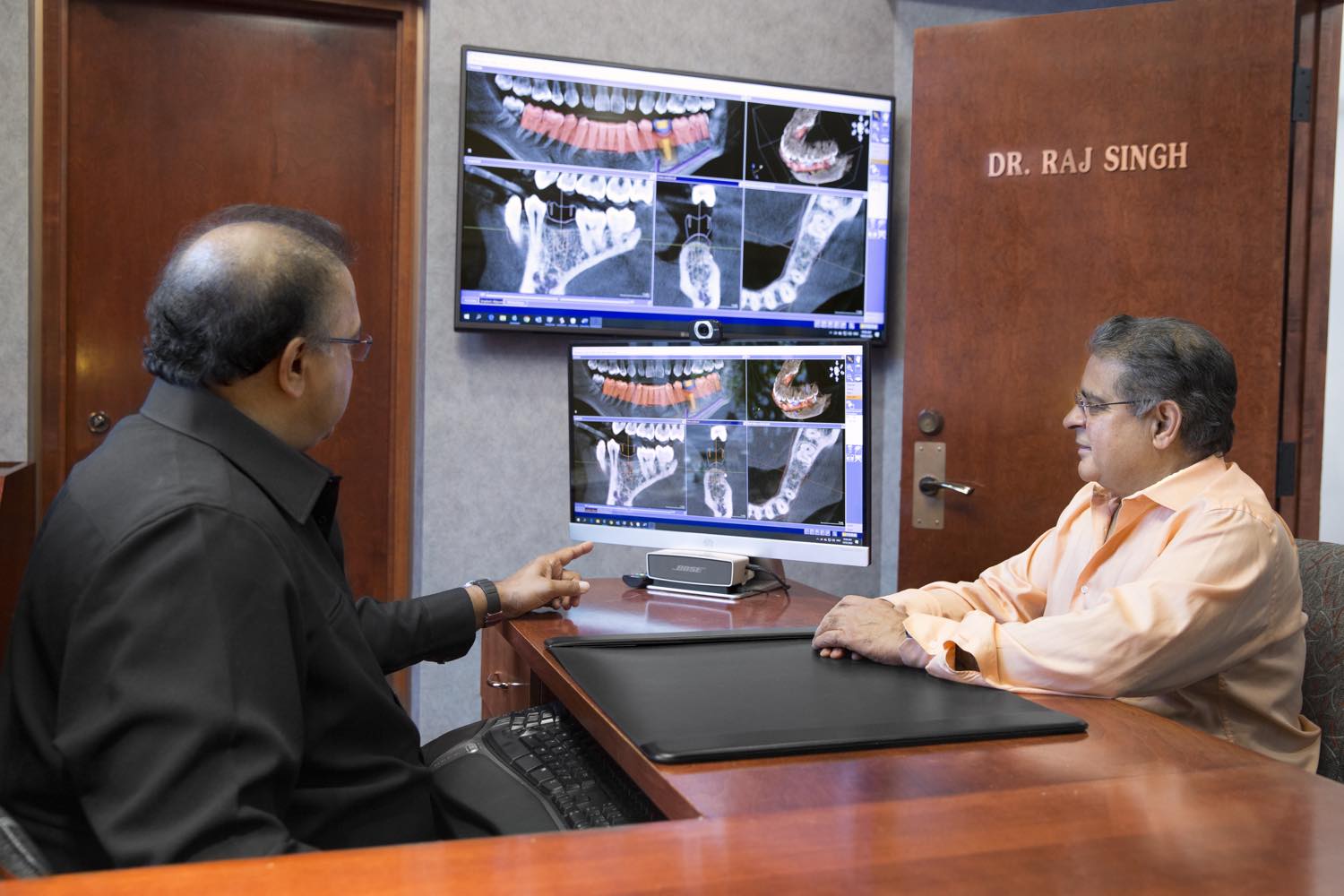
A conventional dental X-ray is two-dimensional. It shows height but not width, and it cannot show where the nerve runs or how close the sinus sits in the third dimension. A cone beam CT scan — a CBCT — shows the bone as a volume, so the implant can be sized and angled to the bone that is actually there.
We take a CBCT for implant cases as a matter of course, and it is included. A quote based on a flat X-ray may be lower, and it is a different standard of planning.
Computer-guided, or freehand
Freehand placement means the surgeon positions the implant by eye and by feel during surgery. Computer-guided placement means the position is decided beforehand on the 3D scan, against where the finished tooth needs to sit, and a surgical guide made to hold the drill to that plan.
The planning and the guide add cost. What they buy is a smaller gap between the plan and the result — the implant placed where the crown needs it rather than where the bone was easiest, which matters most in the front of the mouth and where the bone is tight.
What other implant treatments cost
| Treatment | Typical range |
|---|---|
| Single implant, all in | $3,500 – $6,000 |
| Implant bridge on two implants | $7,000 – $12,000 |
| All-on-4, one arch | $18,000 – $25,000 |
| All-on-6, one arch | $24,000 – $36,000 |
Full-arch figures are per arch. Both arches together cost less than twice one arch, because the planning and much of the laboratory work is shared. All-on-4 and All-on-6 explain which suits which case.
What insurance and public plans actually pay
Neither the Canadian Dental Care Plan nor OHIP covers dental implants. The CDCP excludes them at every income tier — the implant, the abutment, the crown, bone grafting and implant-supported dentures alike. OHIP covers implants only in rare hospital-based cases after major trauma or cancer surgery.
That is worth knowing early, because it is the single most common misunderstanding we hear. If you hold a CDCP card, dentures are the tooth-replacement route it covers.
Private plans usually treat implants as major restorative work at around 50%, against an annual maximum between $1,500 and $2,500. On a $5,000 implant, a plan paying 50% with a $2,000 cap pays $2,000. We verify your coverage before treatment and submit claims for you.
Where a case runs beyond one year's maximum, treatment can often be staged across two benefit years without harming the clinical result. We also offer financing over twelve to sixty months. How payment works.
Questions people ask about implant cost
What does a single dental implant cost in Markham?
A single dental implant costs $3,500 to $6,000 at our practice. That figure is the whole course of treatment: removing the failing tooth, bone grafting where the site needs it, placing the implant, the temporary crown you wear while it heals, and the final crown.
Why is there a range rather than one price?
Because the work differs. A tooth that comes out cleanly and leaves good bone behind needs less than one that has been broken down for years and taken the bone with it. The range is where cases land; your estimate is a single number, given in writing after we have scanned.
Does the price include the crown?
Yes — both of them. The temporary crown you wear while the implant integrates and the final crown are inside the figure. Some practices quote the implant alone and bill the crown separately, so it is worth asking what a quote covers before comparing it with another.
Does it include bone grafting?
Where grafting is needed to support the implant, yes. Some sites need none. Cases needing extensive reconstruction before an implant can be placed are quoted separately, and we will say so at the consultation rather than later.
Does the Canadian Dental Care Plan cover dental implants?
No. The CDCP excludes implants at every income tier — not the implant, not the abutment, not the crown on top, and not bone grafting or implant-supported dentures. It is an absolute exclusion rather than a case-by-case decision. The CDCP does cover dentures, which is the tooth-replacement route open to cardholders. It also covers the extraction and the x-rays that come before an implant — the detail is on our page about the CDCP and dental implants.
Does OHIP cover dental implants?
No. OHIP does not cover dental implants. The rare exceptions are hospital-based procedures after major trauma or cancer surgery, which are arranged through a hospital rather than a dental practice.
How much will my private insurance pay?
Most Ontario plans treat implants as major restorative work at around 50%, against an annual maximum between $1,500 and $2,500. On a $5,000 implant a plan at 50% with a $2,000 cap pays $2,000, not $2,500. Some plans cover the crown but not the implant; some have a waiting period. We verify your coverage before treatment starts.
Is a cheaper implant a worse implant?
Not necessarily, but ask what the difference is. A lower quote may exclude the crown, the grafting, or the 3D scan; it may use a system with no long-term data behind it, or one whose parts are hard to obtain in ten years when something needs replacing. Ask what is included and what happens if the implant does not integrate.
Ready to explore dental implants?
Book a free consultation for an itemised estimate specific to your case. Call (905) 479-7777.