Fixed Bridge Dental Implants for Full Mouth: The Definitive Guide to Permanent Restoration
"Fixed" is the word that matters most to people considering full-arch implants, and it is worth being precise about what it means.
"Fixed" is the word that matters most to people considering full-arch implants, and it is worth being precise about what it means.
It means the bridge is screwed onto implants and you do not take it out. You brush it in your mouth. You sleep in it. You will never hold it in your hand — but we will, roughly once a year, because it comes off for cleaning. That combination confuses people, so here is how a fixed full-arch bridge actually works.
The short version
- Fixed means you do not remove it. It does not mean it can never be removed.
- Screw-retained is the standard for full arches, precisely because it can be unscrewed for maintenance.
- Bite force is far closer to natural teeth than any removable option.
- The underside of the bridge is what you clean, and it is the whole maintenance job.
- Acrylic and zirconia behave quite differently over time.
What the bridge actually is
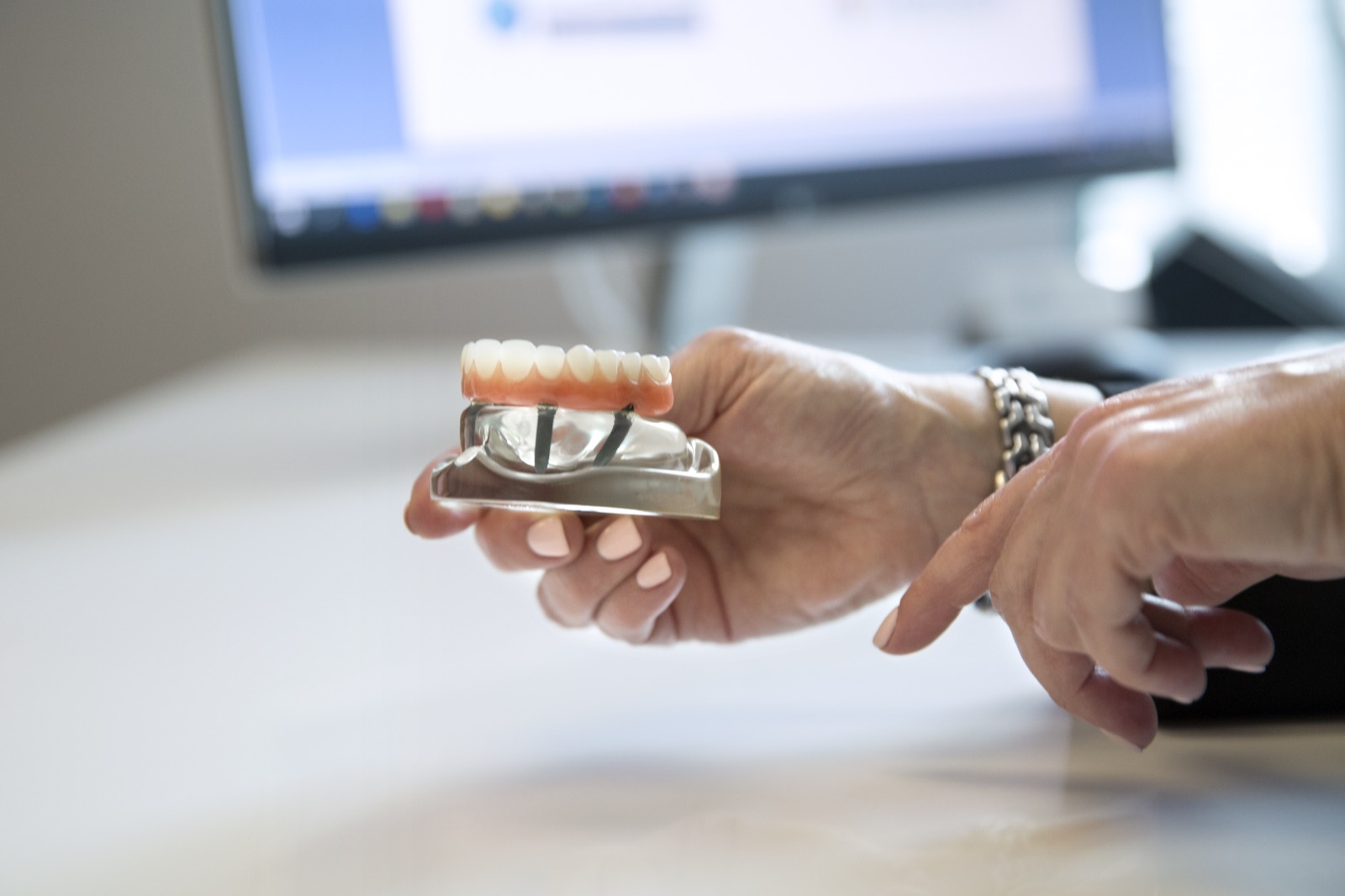
One piece, spanning the whole arch, carrying ten to fourteen teeth. Underneath, it is hollow where it meets your gum, so that a water flosser can pass beneath it.
It attaches to four or six implants through abutments — connectors that sit at gum level and bridge the gap between implant and bridge. Screws pass down through access holes in the biting surfaces of the teeth and are sealed with tooth-coloured filling material. In most cases you cannot see them.
The whole thing is rigid. It does not rest on your gums; it is suspended just clear of them and supported entirely by the implants.
Screw-retained versus cemented
Most patients never hear about this distinction, and it affects the next twenty years.
Screw-retained bridges attach with screws through the teeth. They can be unscrewed in minutes — cleaned underneath properly, a chipped tooth repaired, a component replaced, and refitted. The screws are covered with composite, which is periodically replaced and is the only visible compromise.
Cemented bridges are glued onto abutments. Slightly better looking, since there are no access holes. The problem is retrieval: taking one off often means destroying it. And excess cement can be pushed beneath the gum during fitting, where it is very difficult to remove and is a well-recognised cause of inflammation around implants.
For full-arch work, screw-retained is the sensible default, and it is what we use. If you are quoted a cemented full-arch bridge, ask how it would be removed if an implant needed attention.
Acrylic or zirconia
The choice that moves the cost most, and the one worth thinking about properly.
Acrylic on a titanium frame
Acrylic teeth and pink gum-coloured material over a metal substructure. The lighter and less expensive option.
In its favour: it has some give, which cushions the implants against heavy forces. Repairs are straightforward — a chipped tooth is replaced without remaking the bridge. It is lighter in the mouth.
Against: it wears and stains over years. Coffee, tea, red wine and tobacco all tell. Typically replaced after around a decade, which should be in your long-term budget.
Monolithic zirconia
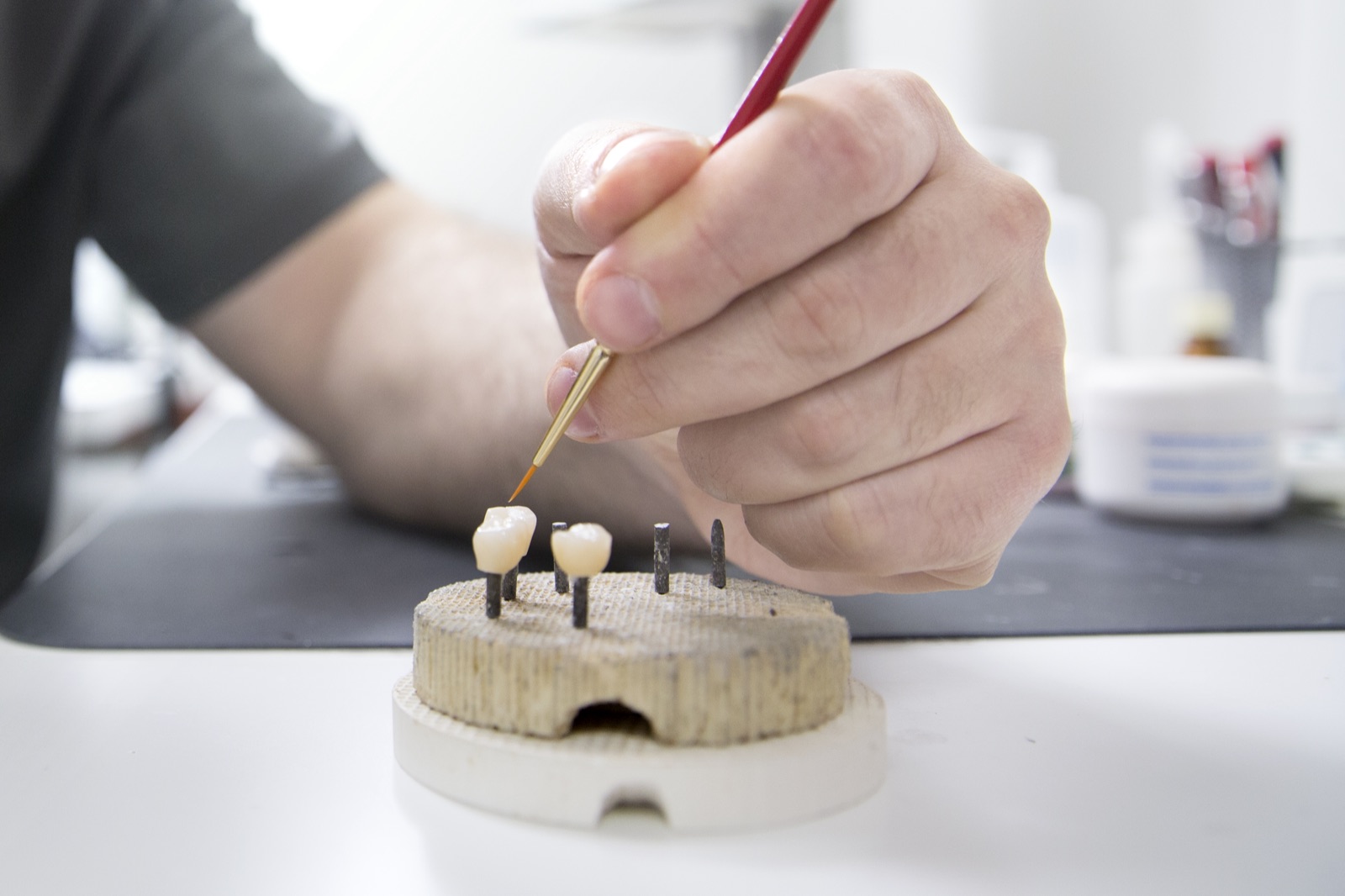
Milled from a single block of dense ceramic, coloured and layered before firing.
In its favour: very hard, holds its colour, does not stain, and looks closer to natural enamel. Generally lasts considerably longer than acrylic.
Against: more expensive. It does not flex, so the bite has to be balanced carefully and more implants are often recommended to support it. If it does fracture, repair is harder and sometimes means remaking.
Broadly: acrylic suits moderate bites and tighter budgets; zirconia suits heavy bites, grinders, and people who want to think about it as little as possible afterwards. Our detailed comparison goes further into the trade-off.
Living with a fixed bridge
Eating. Once integration is complete, essentially normally. Bite force is far greater than with any denture. Most people go back to everything, though it is sensible to be careful with very hard items — bones, ice, nut shells — regardless of material.
Speech. A few days of adjustment, sometimes a slight lisp, then it goes. Reading aloud speeds it up.
Feel. It feels like teeth, with one difference: implants have no ligament, so you sense pressure less precisely than with natural teeth. Most people stop noticing within weeks.
The underside. There is a small space beneath the bridge that you will become aware of with your tongue. That space is deliberate — it is what lets you clean under it — and adapting to it takes a couple of weeks.
Cleaning it
The bridge does not decay. The tissue around the implants can become inflamed, and that is what ends restorations.
Daily: a water flosser traced along the gum line inside and out, angled up under the bridge; interdental brushes passed horizontally into the space between implants; and ordinary brushing of the teeth themselves.
Annually or twice yearly: the bridge is unscrewed, everything cleaned from both sides, the tissue inspected, screws checked and retorqued, and the bridge refitted. This is the part you cannot do at home and the reason screw retention matters.
Our maintenance guide goes through the technique in detail.
Against the removable alternatives
An implant-retained overdenture clips onto two to four implants and is taken out for cleaning. It costs considerably less, it is far more stable than a conventional denture, and it is the proportionate answer for many people — particularly for a lower denture that will not stay put.
A fixed bridge costs more and gives you teeth you never take out, with bite force closer to natural. Whether that difference is worth the money is a genuine judgement rather than a clinical one, and it depends on what is actually bothering you.
Cost
Full arch runs roughly $18,000 to $36,000 per jaw. Within that, the two things that move the figure most are the number of implants — four or six — and whether the bridge is acrylic or zirconia. Grafting, extractions, infection treatment and sedation account for the rest.
Make sure any quotation names the final bridge material explicitly. It is the commonest ambiguity in full-arch pricing.
Seeing whether it suits you
Whether a fixed bridge is the right answer, and on how many implants, comes down to your bone, your bite and what you actually want to change. Book a consultation and we will go through the options including the less expensive ones.
Common questions
Can I take it out myself?
No. It is screwed in and removed only with instruments, by us.
Do I sleep in it?
Yes. It stays in permanently.
Can you see the screw holes?
They are on the biting surfaces and sealed with tooth-coloured material. Most people never notice them; the seals are refreshed periodically.
What if a tooth chips?
On acrylic, usually repaired straightforwardly. On zirconia, small chips can sometimes be polished; larger fractures may mean remaking.
How long does the bridge last?
Acrylic commonly around a decade before replacement; zirconia generally longer. The implants underneath are intended to be long-lasting.
Will food get stuck under it?
Some will, which is why the water flosser is a daily habit rather than an option. It clears in seconds once you have the technique.
Is it heavy?
Zirconia has noticeable weight for the first week or two, then you stop registering it. Acrylic is lighter.
Can it be converted to something else later?
The implants can carry a new bridge, and in some cases an overdenture instead. The implants are the durable part; what sits on them can change.

Free Dental Implant Seminar — No Obligation, No Pressure
"Everything You Need to Know About Today's Dental Implant Treatments" — held monthly at our Markham clinic.
Explore Topics
Written by
Dentistry at Vitality Health
Content creator and writer sharing insights and stories.