Implant Supported Dentures: The Definitive Guide to Full-Arch Restoration
They sit between a conventional denture and a fixed full-arch bridge: real stability, considerably less cost, and still removable for cleaning. If your complaint is a lower denture that will not stay where you put it, this is often the proportionate answer rather than the expensive one.
Implant-supported dentures are the option most people are not told about, and for a lot of them it is the right one.
They sit between a conventional denture and a fixed full-arch bridge: real stability, considerably less cost, and still removable for cleaning. If your complaint is a lower denture that will not stay where you put it, this is often the proportionate answer rather than the expensive one.
The short version
- Two to four implants with attachments; the denture clips on and you take it out to clean.
- Costs a fraction of a fixed full-arch bridge.
- Transforms a lower denture in particular, where suction has never worked well.
- You still remove it at night, and it still covers your palate in some upper designs.
- The clip inserts wear and need replacing periodically — a small, recurring cost.
How it works
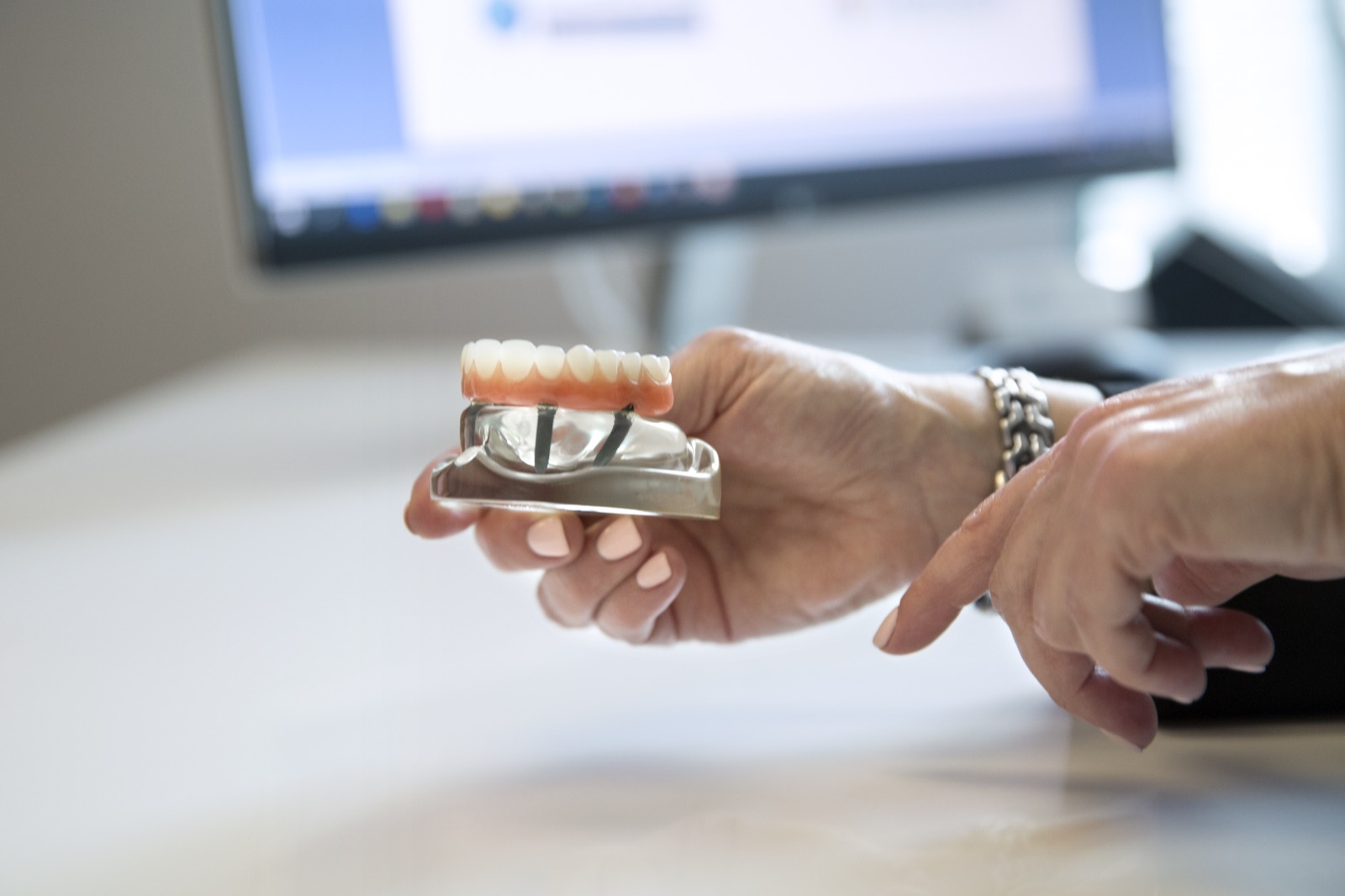
Implants are placed in the jaw as usual. Instead of a bridge being screwed onto them, each implant carries a small attachment that projects just above the gum. Corresponding housings are set into the fitting surface of the denture.
You push the denture down and it clicks into place. You pull it out to clean it. In between, it does not move.
Two designs are common:
Locator attachments — a stud on each implant, with a nylon insert in the denture that grips it. Simple, inexpensive to maintain, and the usual choice. The inserts come in different retention strengths, so the grip can be tuned to what you find comfortable.
Bar attachments — a custom metal bar joining the implants, with clips in the denture that grip the bar. More retentive and better at distributing load, but more expensive and more demanding to clean underneath.
How many implants
Two, lower jaw. The most common and most cost-effective arrangement. Two implants at the front of the lower jaw, where bone is usually densest. This alone resolves most of what people hate about lower dentures.
Four, lower jaw. More stability, less rocking at the back, less pressure on the gums. Worth the difference for people who chew heavily.
Four, upper jaw. Upper jaws need more, because the bone is less dense and the denture is larger. Two is generally not enough up there.
Six, upper jaw. Enough support to remove the palate from the denture, which transforms the experience of eating — you get taste and temperature back. For many upper denture wearers this is the change that actually matters.
Who it suits
The lower denture wearer. Lower dentures have almost no suction to work with, because the tongue and the shape of the ridge work against them. People use adhesive, avoid foods, and speak carefully. Two implants ends that, and it is the clearest case for this treatment in dentistry.
People for whom a fixed bridge is out of reach. An overdenture delivers a large share of the practical benefit at a much lower cost.
People with significant bone loss. An overdenture needs fewer implants and less bone volume than a fixed bridge, so it sometimes avoids grafting that a fixed option would require.
People who find cleaning difficult. Being able to take it out and clean it in your hand is genuinely easier than cleaning under a fixed bridge, and for someone with limited dexterity that is a real clinical argument.
What it does not do
Worth being straight, because this option is sometimes oversold as "implants" without qualification.
You still take it out. At night, and to clean. For some people that is the whole thing they wanted to escape.
It still rests partly on your gums. The implants provide retention; the ridge still bears some load. Sore spots and occasional relines remain part of life, though far less than with a conventional denture.
Bite force is better, not equal. Much stronger than a conventional denture, still short of a fixed bridge.
Upper designs often still cover the palate unless you have enough implants to avoid it.
The inserts wear. Nylon locator inserts lose grip over months to a couple of years and are replaced — a quick, inexpensive appointment, but a recurring one.
Against a fixed bridge
The honest comparison.
Choose the overdenture if cost is a real constraint, if your main problem is a lower denture that moves, if bone is limited, or if cleaning a fixed bridge would be difficult for you.
Choose fixed if not removing your teeth matters to you, if you want maximum bite force, or if you want the ridge shrinkage under a denture to stop as completely as possible.
Many people who can afford either still prefer fixed, and that is a reasonable preference. But paying three times as much for a benefit you do not particularly want is not obviously wise, and we would rather say so.
Cost
An implant-supported overdenture costs substantially less than a fixed full arch, which runs roughly $18,000 to $36,000 per jaw. Two implants with locators and a new denture is a fraction of that; four implants or a bar arrangement sits higher.
What moves the figure: the number of implants, locator versus bar, whether you need a new denture or your existing one can be adapted, and whether grafting or extractions are required first.
Ongoing: insert replacements periodically, relines every few years, and eventual denture replacement. Modest, but real.
Working out which you need
The useful conversation starts with what is actually bothering you — movement, diet, appearance, the palate, or the fact of taking it out at all. Different answers point to different treatments. Book a consultation and we will start there rather than with a product.
Common questions
Do I take it out at night?
Yes. Leaving it in overnight risks tissue inflammation, and the gums benefit from the rest.
Will it click when I eat?
It should not. Occasional clicking usually means the inserts have worn or the fit needs adjusting — easily corrected.
Can my current denture be converted?
Sometimes, if it is in good condition and fits well. Often a new one is better, because the denture needs adequate thickness where the housings sit.
How long do the inserts last?
Months to a couple of years depending on how hard you chew. Replacing them is quick and inexpensive.
Will it stop my jaw shrinking?
Partly. The implants preserve bone around themselves; the areas bearing denture pressure continue to change more slowly than with a conventional denture.
Is the surgery the same as for a fixed bridge?
Similar but smaller — fewer implants, and often no extractions if you are already a denture wearer. Recovery is generally easier.
Can I upgrade to fixed later?
Sometimes, if the implants are positioned suitably and there are enough of them. Say at the planning stage if you think you may want to, because it affects where they go.
Do I still need check-ups?
Yes. The implants and the tissue around them need monitoring, and the denture fit needs reviewing.

Free Dental Implant Seminar — No Obligation, No Pressure
"Everything You Need to Know About Today's Dental Implant Treatments" — held monthly at our Markham clinic.
Explore Topics
Written by
Dentistry at Vitality Health
Content creator and writer sharing insights and stories.