Full Arch Dental Implant Recovery: A Comprehensive 2026 Guide
Most accounts of implant recovery stop after the first week, which is the part people ask about but not the part that takes the longest. Full-arch treatment runs three to six months from surgery to final teeth, and the bulk of that is a quiet stretch where nothing hurts, nothing appears to be happening, and you are living on soft food.
Most accounts of implant recovery stop after the first week, which is the part people ask about but not the part that takes the longest. Full-arch treatment runs three to six months from surgery to final teeth, and the bulk of that is a quiet stretch where nothing hurts, nothing appears to be happening, and you are living on soft food.
This is a guide to that whole stretch — what happens at each stage, which appointments matter, and when you get your life back.
The short version
- Two things are healing on different clocks: gum tissue in weeks, bone in months.
- You leave with fixed temporary teeth the same day. They are not the final ones.
- Soft food for around three months. This is the hardest part for most people, and it is boredom rather than pain.
- The two-week review matters more than it sounds — small problems are easy to fix then.
- The final bridge is fitted once the bone has integrated, usually between months four and six.
Two clocks running at once
It helps to separate them.
Soft tissue — gums, stitches, swelling — settles in two to three weeks. This is the healing you can see and feel.
Bone takes three to six months. The implant surface and the bone grow into one another, and you feel nothing while it happens. Lower jaws are generally quicker than upper; denser bone integrates faster.
Almost everything you are asked to do during recovery protects the second process. You will feel fine long before the bone is ready, which is exactly why the restrictions feel unnecessary and exactly why they matter.
Week one
Covered in more detail in our piece on what the surgery feels like, but briefly: swelling peaks around day three, then turns. Most people are back at work by day four or five. Liquids and very soft food throughout.
The temporary bridge is in place from day one. It looks like teeth and functions enough to talk and eat softly. It is deliberately not as strong as the final one.
The two-week review
This appointment is worth keeping even if you feel fine.
Stitches come out if they are not dissolving. We check how the gums are settling, whether the temporary bridge is rubbing anywhere, and whether the bite has shifted as the swelling has gone down.
Small adjustments here prevent bigger problems. A bridge that rubs for a week causes an ulcer; a bite slightly out of balance loads one implant more than the others during the months when they are least able to take it. Both take minutes to correct at this stage.
We also check your cleaning. Most people are being too cautious by now — afraid of disturbing something. The area needs to be kept clean, gently.
Weeks three to twelve: the quiet part
From here, little appears to happen, and that is the point.
You will feel normal. The swelling is gone, the gums have settled, and the teeth feel like teeth. The temptation to start eating properly becomes strong.
Resist it. The implants are not yet fused; they are held by friction and early bone growth. Biting into something hard can produce movement too small to feel and enough to interrupt integration. This is the single most common way full-arch treatment goes wrong, and it is entirely avoidable.
What soft food actually means
The practical test: if you can cut it with the side of a fork, it is fine.
Weeks 1 to 2: liquids and purées. Soups, smoothies, yoghurt, blended anything. Lukewarm rather than hot. No straws for the first fortnight — the suction can disturb clots.
Weeks 2 to 12: soft solids. Scrambled eggs, flaked fish, well-cooked pasta, mashed vegetables, soft cheese, minced meat in sauce, tinned fruit.
Avoid throughout: nuts, seeds, popcorn, crusty bread, raw carrot, apples, toffee, ice, anything requiring a decisive bite.
People underestimate how wearing this becomes by week six. It is worth planning some variety in advance rather than eating the same three things.
Speech
Most people have a slight lisp for a few days while the tongue learns the new shape. Reading aloud helps and it resolves quickly. If it persists beyond two weeks, mention it — the bridge may be thicker than it needs to be in one place.
Cleaning during this phase
A soft manual brush around the bridge from day two, gently. Salt-water rinses. No electric brush and no water flosser for the first couple of weeks — both are too forceful for healing tissue. After the two-week check we will show you how to clean underneath, which becomes your permanent routine.
Exercise
Walking within a few days. Nothing that raises your heart rate significantly for seven to ten days — you will feel throbbing if you push it, which is your answer. Contact sport waits until the final bridge is fitted.
Months four to six: the final bridge
When integration is confirmed, the last stage begins. It is several appointments rather than one.
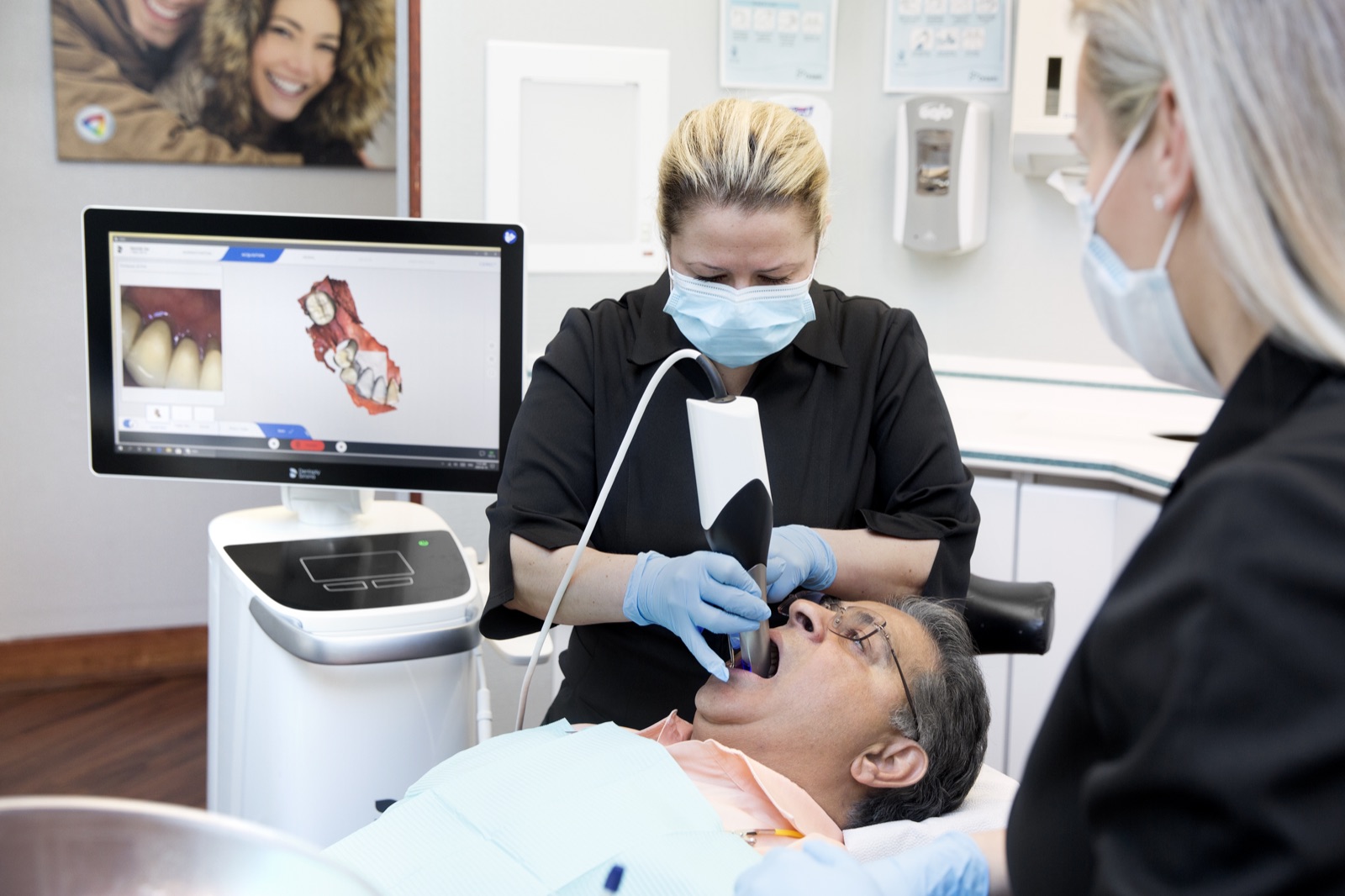
The temporary comes off and the implants are checked individually for stability. New impressions or scans are taken, now that the gums have finished changing shape — one reason the final bridge cannot simply be made at the start.
Then a try-in. You see the teeth before they are finished: shape, length, shade, how much shows when you smile and talk. This is the moment to be fussy. Changes here are straightforward. Changes after the bridge is milled are not.
People are often too polite at this appointment. If the teeth look too white, too long, too even — say so. You are going to look at them every day for years.
The final bridge is then fitted and the bite carefully balanced, particularly with zirconia, which does not flex.
After that
You can eat normally. Most people go for something they have missed — steak, an apple, toast — and describe it as the moment the whole thing was worth it.
From then on it is maintenance: cleaning under the bridge daily with a water flosser and interdental brushes, and a professional clean with the bridge unscrewed once or twice a year. That is permanent, and it is what protects the implants.
What to watch for at any stage
- Pain that worsens after the first week rather than improving
- Any movement in the temporary bridge
- A bad taste or smell, or pus
- Swelling that increases after day four
- A tooth on the temporary that chips or comes loose
Most are minor and fixable. All are worth a call rather than a wait.
What genuinely slows recovery
Smoking — the clearest single factor. It restricts blood supply to healing bone. If there is one period to stop, this is it.
Chewing too early. The main avoidable cause of failure.
Poorly controlled diabetes, which slows healing generally.
Skipping reviews. Problems caught at two weeks are minor. The same problem at three months may not be.
A realistic timeline
- Day 0 — surgery, temporary teeth fitted
- Days 1–3 — swelling builds, peaks
- Days 4–7 — improves; most return to work
- Week 2 — review, stitches, adjustments
- Weeks 3–12 — feel normal, eat soft, nothing visible happening
- Months 4–6 — integration confirmed, impressions, try-in, final bridge
- Thereafter — daily cleaning, professional maintenance twice a year
If you would like to know what your own timeline looks like — which depends on your bone, how many teeth are being removed and whether grafting is needed — book a consultation and we will map it out.
Common questions
How long until I can eat normally?
Around three months, sometimes longer in the upper jaw. You will feel ready well before you are, which is precisely why the restriction exists.
How long off work?
Three to five days for most people; a week if your work is physical. You are limited by swelling and tiredness rather than pain after the first couple of days.
Will I be without teeth?
No. A fixed temporary bridge goes on the same day. It is lighter and less strong than the final one, which is intentional.
What if I bite something hard by accident?
Tell us. One incident is usually fine, but we would rather check stability than assume. Do not wait for your next scheduled appointment.
Why can't the final bridge be made straight away?
Because your gums are still changing shape. A bridge made on day one would not fit the tissue three months later, and the implants need to be integrated before taking full load.
Can I use an electric toothbrush?
Not for the first two weeks. After that, yes, around the bridge. The water flosser also waits until the two-week check.
How will I know it has worked?
We check each implant for stability before making the final bridge. If one has not integrated, it is better to find out then — it is removed, the site heals, and it is replaced.
Does smoking really matter that much?
Yes. It is the clearest lifestyle factor in implant failure. If you cannot stop permanently, stopping for this period alone measurably improves your odds.

Free Dental Implant Seminar — No Obligation, No Pressure
"Everything You Need to Know About Today's Dental Implant Treatments" — held monthly at our Markham clinic.
Explore Topics
Written by
Dentistry at Vitality Health
Content creator and writer sharing insights and stories.