The Success Rate of All-on-6 Implants: A 2026 Clinical Overview
Published figures for implant survival are high, and they come from studies with selected patients, defined follow-up and specific definitions of what counts as success. Quoting one at you tells you about those patients rather than about you. What is genuinely useful is knowing what determines the outcome in your own case — because most of the factors are identifiable in advance, and several are within your control.
People ask about success rates expecting a number, and a number is the least useful answer we could give.
Published figures for implant survival are high, and they come from studies with selected patients, defined follow-up and specific definitions of what counts as success. Quoting one at you tells you about those patients rather than about you. What is genuinely useful is knowing what determines the outcome in your own case — because most of the factors are identifiable in advance, and several are within your control.
The short version
- "Survival" and "success" are not the same thing, and the distinction matters when comparing claims.
- Six implants means one failure leaves five working, not three.
- Smoking is the clearest modifiable risk factor.
- Most failures happen early, in the first months, rather than years later.
- The long-term threat is not the implant. It is inflammation in the tissue around it, which is a cleaning problem.
What "success" actually means
Three different things get reported under the same word.
Implant survival — the implant is still in the jaw. This is the highest number and the least demanding definition.
Implant success — it is still there, stable, with healthy bone around it and no inflammation. A stricter standard.
Prosthetic success — the bridge itself is intact and functioning, without fractures or repeated repairs. This is usually the lowest of the three, because bridges chip and wear while implants sit quietly in bone.
When you see a high figure quoted in an advertisement, it is almost always survival. That is not dishonest, but it is the easiest bar. Ask which one is being reported.
What six implants changes
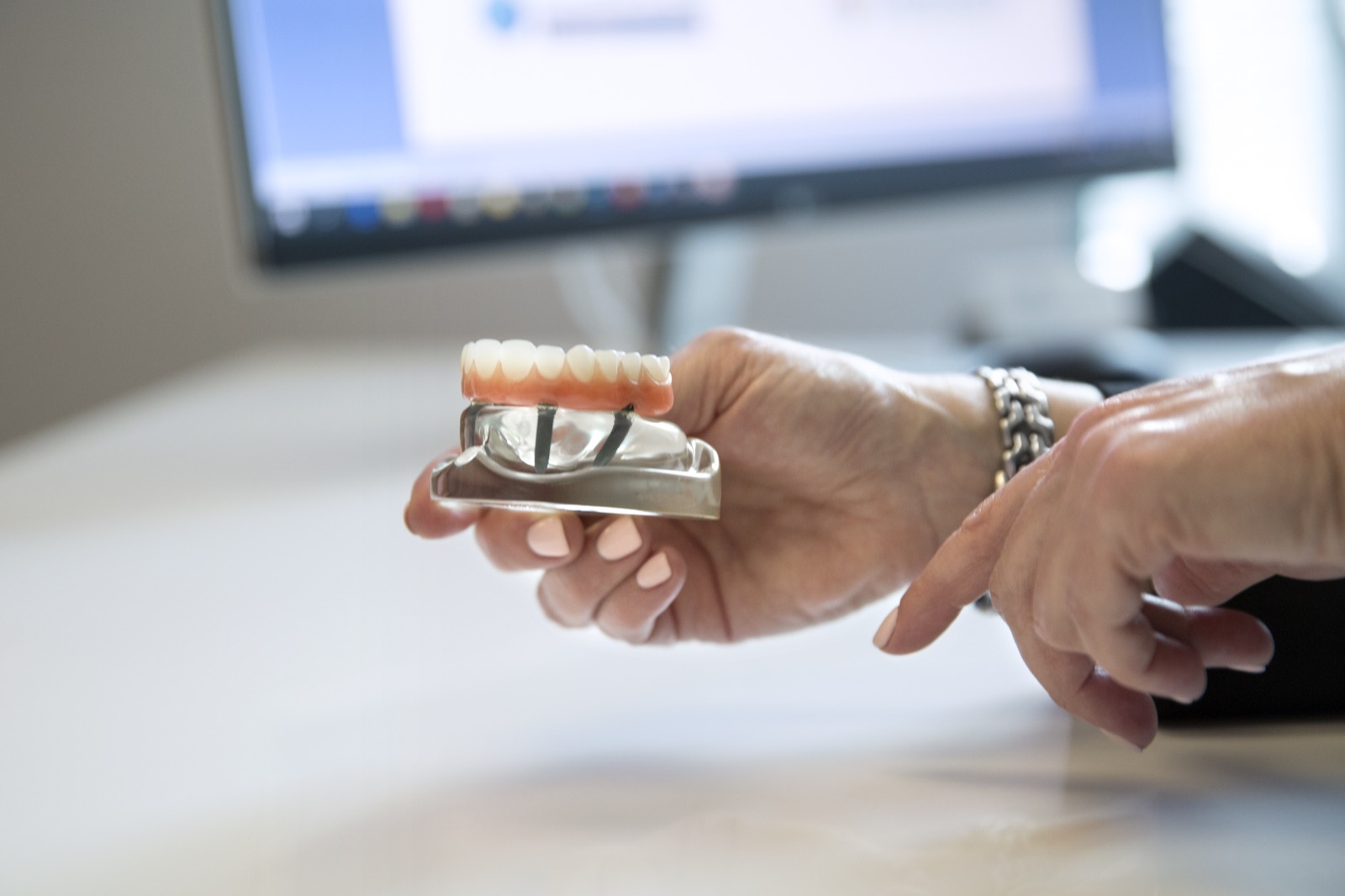
Not the odds of any individual implant integrating — that depends on bone and healing, not on how many neighbours it has. What changes is the consequence of one failing.
Lose one of six and the bridge is supported by five. Lose one of four and it is down to three, which is generally not enough for a full arch and usually means the implant has to be replaced before the final bridge can be fitted.
Six also distributes the load. Each implant carries less, which matters for people with strong bites, grinding habits, or a rigid zirconia bridge that does not flex to absorb force.
This is why six is often chosen for the upper jaw, where bone is typically less dense than the lower.
Early failure and late failure
These have different causes and it helps to separate them.
Early failure means the implant never integrates. It happens in the first weeks to months, and the usual causes are movement during healing, poor bone quality at the site, smoking, or infection. It is disappointing but it is recoverable: the implant is removed, the site heals, and it is replaced. This is why implants are checked individually for stability before the final bridge is made.
Late failure means an implant that integrated and then lost its bone support years later. Almost always this is peri-implantitis — chronic inflammation in the tissue around the implant, driven by plaque that was not removed. It is slow, it is usually painless until late, and it is largely preventable.
The practical implication: the first three months are about protecting integration, and everything after that is about cleaning.
What actually moves the odds
Things you control
Smoking. The clearest single factor. It constricts blood supply to healing bone and raises the risk of both early failure and later peri-implantitis. If there is one period in your life to stop, the months around implant surgery is it.
Chewing too early. The most common avoidable cause of early failure. The implants feel solid long before they are fused. Soft food for around three months is not caution, it is the treatment.
Daily cleaning under the bridge. A water flosser and interdental brushes, every day, permanently. This is what determines whether you are still happy with the result in fifteen years.
Keeping maintenance appointments. The bridge is unscrewed, cleaned underneath properly, and the tissue checked. Once or twice a year. Peri-implantitis caught early is manageable; caught late it is not.
Things you partly control
Diabetes, where control matters more than diagnosis. Well-managed diabetes is compatible with successful implant treatment; poorly controlled diabetes slows healing.
Grinding and clenching. A night guard protects the bridge from forces it was not designed for.
Things that are simply your anatomy
Bone density and volume, which the scan measures. Which jaw — lower generally integrates faster than upper. Previous gum disease, which raises peri-implantitis risk and makes the cleaning routine more important, not impossible.
None of these rule treatment out. They change the plan — more implants, grafting first, a different material, closer monitoring.
Why planning affects the outcome
An implant placed where there is genuine bone, at an angle that lets the bridge seat without tension, in a position you can actually clean around, has a different long-term trajectory from one placed where it happened to fit.
Two things follow from this. Implants have to be positioned so that a brush or water flosser can reach underneath — a bridge that cannot be cleaned will eventually develop inflammation regardless of how well the surgery went. And all six positions have to be planned together so the bridge seats passively, because permanent tension on implants is a load they were never designed to carry.
This is the practical argument for computer-guided placement in full-arch cases, which we cover separately.
If one does fail
It is worth knowing this is a manageable event rather than a catastrophe.
If it happens before the final bridge, the implant is removed, the site is allowed to heal for a few months, and another is placed. Your temporary bridge continues in the meantime.
If it happens years later, the options depend on the remaining five — sometimes the bridge is fine on five implants, sometimes a replacement is placed. It is a repair, not a restart.
Understanding your own case
Everything above becomes specific once we can see your scan and your history. Book a consultation and we will go through the factors that apply to you, including the ones that argue against treatment if there are any.
Common questions
Why won't you give me a success rate?
Because a figure from a study of other people, under a definition of success you have not been told, is not information about you. What affects your outcome is knowable and more useful.
Is All-on-6 more reliable than All-on-4?
Both are well-established. Six is more forgiving of a single failure and spreads load better, which matters most in softer bone, heavier bites, and with rigid zirconia bridges.
How long do they last?
The implants are intended to be long-lasting, and in most people they are. The bridge on top is a wearing part — acrylic often needs replacing after roughly a decade, zirconia generally lasts longer.
Will I know if something is going wrong?
Not always, which is why reviews matter. Peri-implantitis is often painless until it is advanced. Bleeding when you clean around the bridge is the early sign worth reporting.
Does grinding my teeth rule me out?
No, but it changes the plan — usually more implants, possibly a different material, and a night guard.
I smoke. Should I not bother?
You can still be treated, and you should know the risk is genuinely higher. Stopping for the treatment period alone measurably improves the odds, and many people find it becomes permanent.
What is the most important thing I can do?
Clean underneath the bridge every day, and keep your maintenance appointments. Past the first three months, that is most of what determines the long-term result.
Can an implant be replaced in the same place?
Usually, after the site has healed — often three to four months. Occasionally grafting is needed first.

Free Dental Implant Seminar — No Obligation, No Pressure
"Everything You Need to Know About Today's Dental Implant Treatments" — held monthly at our Markham clinic.
Explore Topics
Written by
Dentistry at Vitality Health
Content creator and writer sharing insights and stories.