
Technology & Patient Resources
Photogrammetry in implant dentistry
Digital capture technology producing highly accurate 3D models of implant positions — so a full-arch prosthesis fits the first time.
The problem it solves
A full-arch prosthesis must fit passively — seating on all its implants without being forced into position. A prosthesis that has to be forced places continuous stress on the implants, the bone around them, and the prosthetic components themselves.
The difficulty is capturing several implant positions accurately enough across a whole arch. Conventional impression techniques accumulate small errors across that distance, and small errors at the arch level become significant misfit at the implant level.
How it works
Reference markers
Specialised markers are attached to each implant, giving the system fixed, identifiable points to measure between.
Multi-angle photography
Multiple photographs are captured from different angles around the arch.
3D model generation
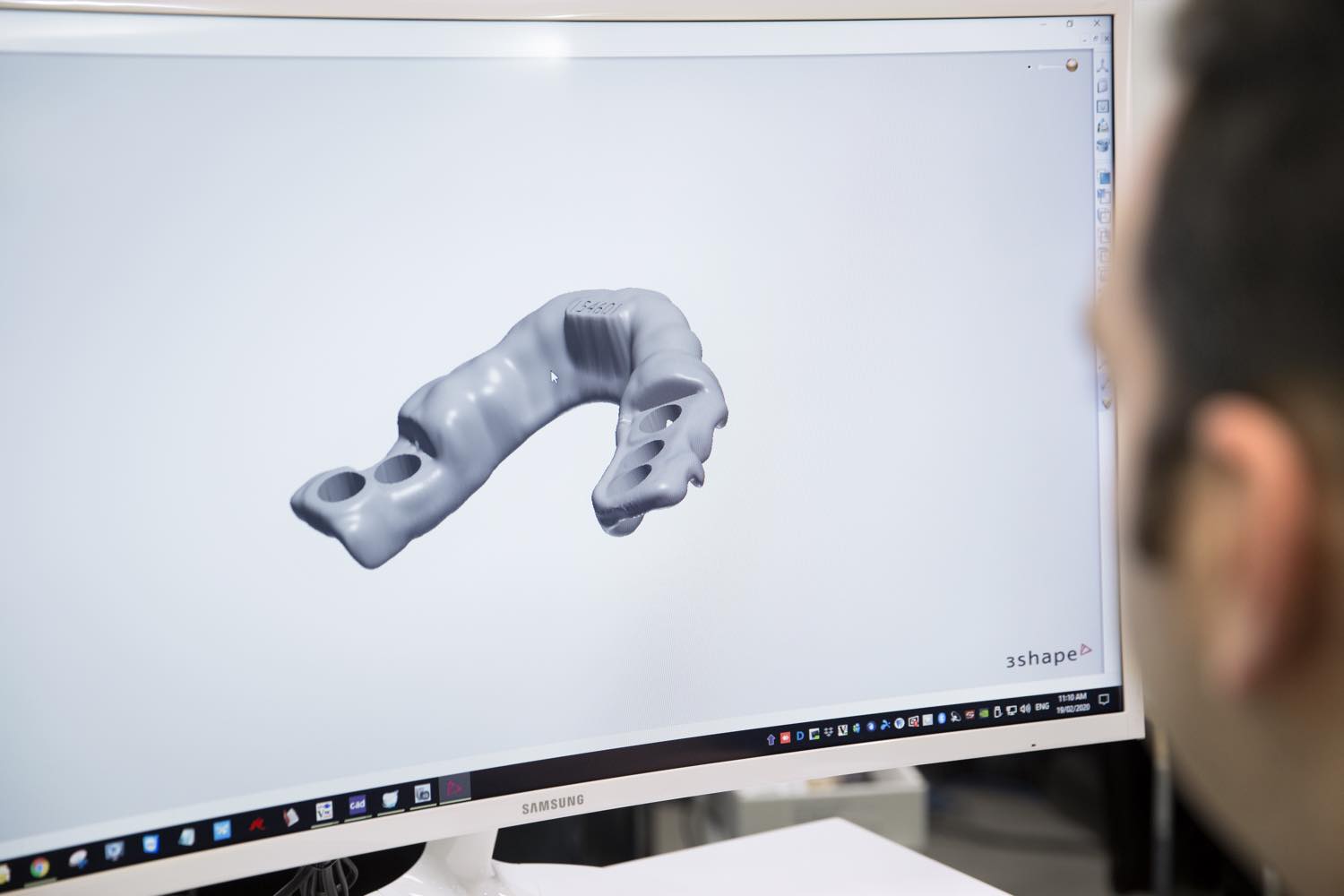
Those images are processed into precise, measurable 3D data defining the exact spatial relationship between every implant — which then drives prosthesis fabrication.
Where it adds the most value
All-on-4 & All-on-6 Cases
Full-arch work is where photogrammetry earns its place. The greater the span between implants, the more conventional techniques struggle.
Complex Multi-Implant Restorations
Cases needing both esthetic and functional precision across several implants, where cumulative error would otherwise compromise the result.
The practical benefit
A prosthesis that fits the first time — which means fewer adjustment appointments, fewer remakes, and considerably less time in the chair.
It also means the implants are loaded as designed rather than fighting a prosthesis that does not quite match them, which is the kind of low-grade stress that shortens the life of full-arch work.
Have a question?
Call (905) 479-7777 to discuss full-arch treatment.