
Technology & Patient Resources
Advanced dental technology
Equipment chosen for clinical precision and better outcomes rather than for how it sounds in a brochure.
Technology in dentistry is easy to market and harder to justify. Our test is straightforward: does it make diagnosis more accurate, treatment more predictable, or the experience meaningfully better for the patient?
Everything below earns its place on at least one of those counts, and most on all three.
What we use
3D Imaging (Cone Beam CT)
High-resolution three-dimensional imaging for implant planning and bone assessment — showing depth, nerve position, and sinus anatomy that a flat x-ray cannot.
Computer-Guided Surgery
Placement follows a path planned before surgery, for implants and complex extractions, using surgical guides printed from that plan.
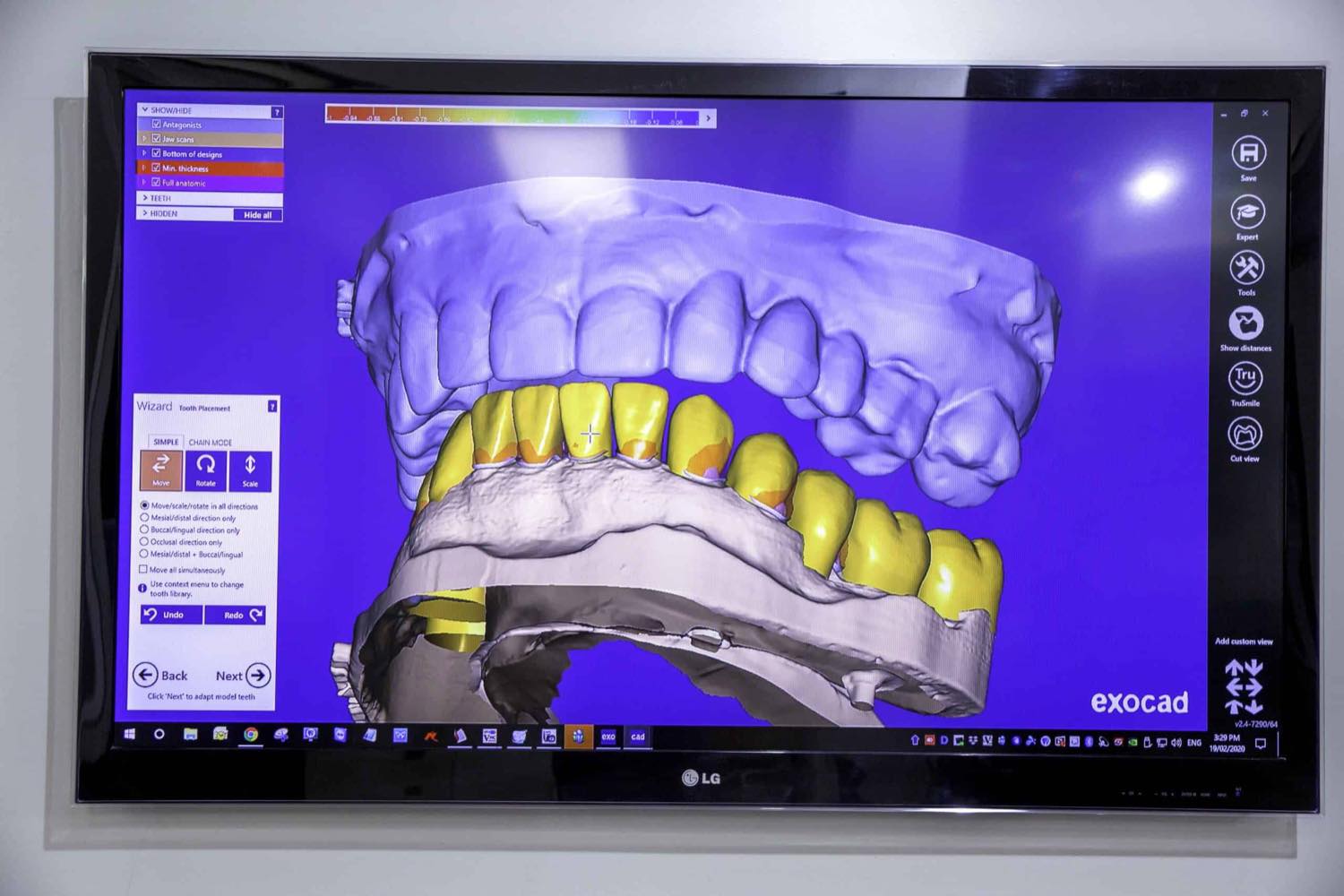
Digital Dental Lab
In-house fabrication of crowns, dentures, and implant restorations, with direct collaboration between the technician and your dentist.
CAD/CAM Restorations
Computer-designed and milled crowns, veneers, and inlays, enabling single-visit treatment with no temporaries.
Intraoral Scanners
Digital impressions taken in minutes, without trays or impression material — faster, more comfortable, and considerably more accurate.
Digital X-Rays & Lasers
Low-radiation imaging available instantly on the operatory screen, plus soft tissue lasers for minimally invasive procedures.
The point is that it connects
Individually these are useful tools. Together they form a single digital chain — the scan that diagnoses your problem is the same dataset that plans the surgery, designs the restoration, and drives the mill that makes it.
Nothing is re-scanned, re-measured, or transcribed by hand between stages, which is where accuracy is usually lost.
What each of these actually changes for you
Equipment lists are not very useful on their own. Here is what each piece changes about your appointment or your treatment.
- 3D cone beam CT. Captures the whole jaw in about ten seconds. A flat x-ray shows height and width; this shows depth as well, which is what tells us where a nerve runs and how much bone is actually there before an implant is planned rather than during surgery — in-house 3D CBCT scanning.
- Intraoral scanner. Replaces the tray of impression material. Most people find it considerably more comfortable, and it matters most if you have ever gagged on an impression.
- Computer-guided surgery. The implant position is decided before the day, and a printed guide directs the drill along that plan instead of it being judged freehand — computer-guided implant surgery.
- In-house digital laboratory and mill. A crown can be designed, milled and fitted at one appointment, and a shade adjusted while you are still in the chair rather than posted back to a laboratory — same-day crowns.
- Digital x-rays. Lower dose than the film they replaced, and viewable immediately, which matters when something is hurting today — digital x-rays.
The point is not the equipment, it is that it connects
Any practice can buy a scanner. The thing that changes clinically is when the scan, the plan, the guide and the mill all read from the same file, so nothing has to be measured by hand and copied across between stages.
That chain is worth understanding on its own terms, including where the evidence supports it and where it does not — how the digital workflow works covers it properly, with the research attributed.
How we decide whether something is worth buying
Technology in dentistry is easy to market and harder to justify. Three questions decide it here.
- Does it make the diagnosis more accurate? A CBCT scan answers questions a flat x-ray cannot. That is a genuine diagnostic gain.
- Does it make treatment more predictable? A surgical guide means the position is decided when there is time to think about it, rather than during surgery.
- Does it make the appointment better for the patient? Fewer visits, no impression material, no temporary crown to come loose. These are small things individually and they are most of what people actually notice.
Anything that only passes the marketing test does not get bought.
What technology does not do
Worth being straight about, because the industry is not always.
- It does not diagnose. Software measures and displays. Deciding what a finding means, and whether it needs treating at all, is clinical judgement.
- It does not make a poor plan good. A precisely executed plan that was wrong to start with is precisely wrong.
- It does not remove biology. Healing, bone quality and gum health decide outcomes, and none of those is a data problem.
- It is not always the right route. For some cases a conventional impression or a laboratory-layered crown is still the better answer, and we will say so rather than defaulting to whatever is newest.
Common questions
Do I need a 3D scan for every visit?+
No. A CBCT scan is taken where it is clinically indicated, most often for implant planning, and not as a routine part of a check-up. Imaging is used where it answers a question that cannot be answered another way.
Is an intraoral scan better than the old impression putty?+
For single crowns and short-span bridges, reviews find the two comparable rather than one clearly better. Most patients prefer the scan and gag less, which is a real advantage even where the accuracy is a draw.
Does having a mill on site mean every crown is same-day?+
Most, not all. Some cases still suit a laboratory-layered crown over two visits, usually for shade-matching at the front of the mouth. We will tell you which yours is.
Does computer-guided surgery mean the implant goes exactly where planned?+
Very close, not exactly. Reviews of guided surgery report deviations of roughly two to four degrees and about a millimetre at the implant head. A guide narrows the gap between plan and result; it does not close it.
Is digital x-ray radiation lower than film?+
Yes, digital sensors need less radiation than the film they replaced, and the image is available immediately. We still only take images where they are clinically indicated.
Have a question?
Book a consultation and see your own imaging on screen. Call (905) 479-7777.