
Our Technology
3D facial scanning: planning your new teeth around your face
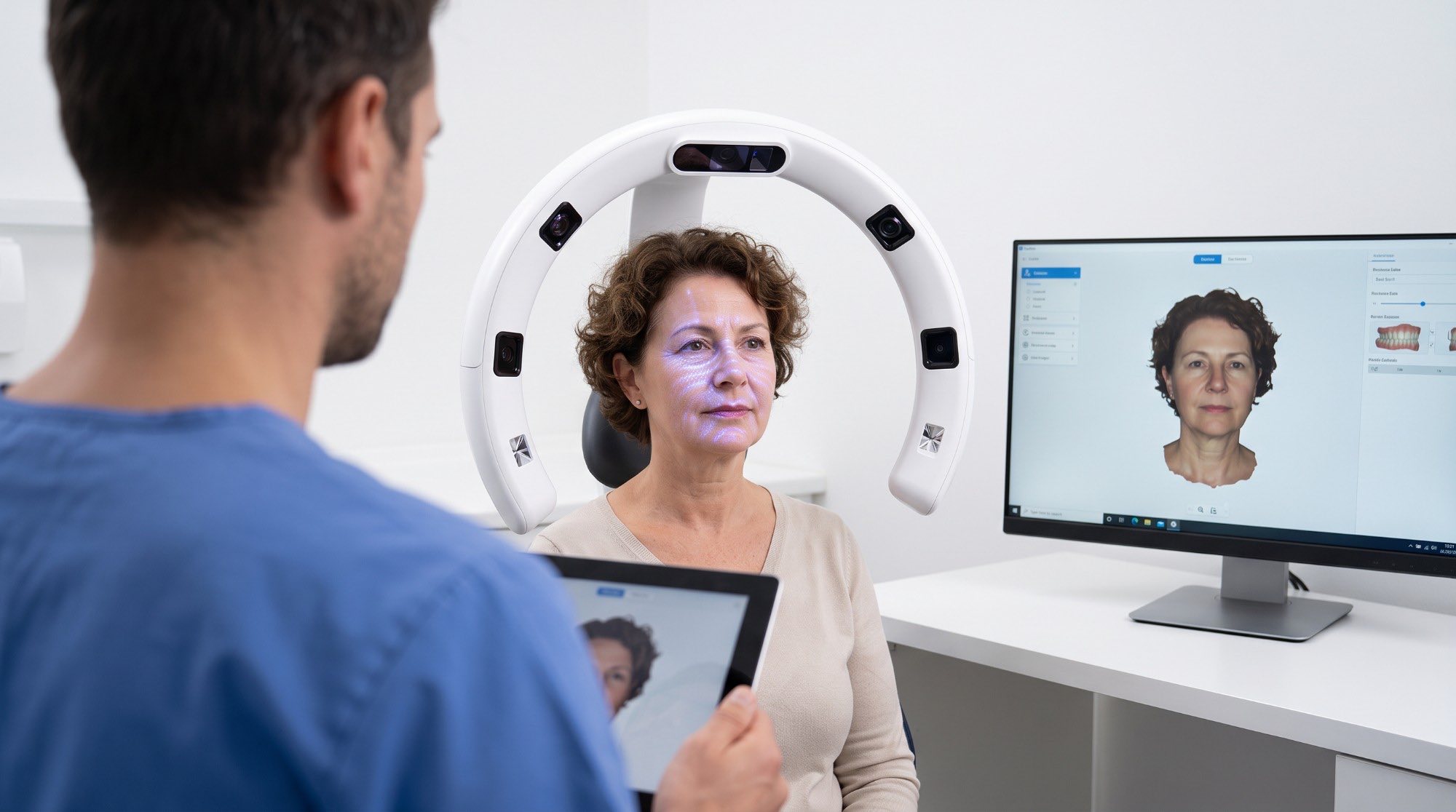
Teeth are not designed in isolation. A three-dimensional scan of your face lets us plan the position, size and shape of new teeth against your lips, your smile and your profile before anything is made.
Reviewed by Dr. Raj Singh, Implant Dentist, Dentistry at Vitality Health
3D facial scanning captures the shape of your face, lips and smile in three dimensions in a few seconds, without radiation. We combine that scan with your 3D CBCT bone scan and a digital scan of your teeth and gums to build a complete digital model of you, often called a virtual patient. New teeth are then designed on that model, so a full-arch implant bridge or a smile makeover is planned to suit your face, not just your jaw.
For most of the history of dentistry, new teeth were designed on a plaster model of the mouth, and how they would look in the face was judged by eye at a try-in. That works for a single crown. For a full set of teeth on implants, where the position of the teeth also decides how the lips are supported and how the face looks at rest, it leaves too much to chance.
Facial scanning closes that gap. This page explains what the scan is, how it fits with the other digital records we take, what it changes in full-arch implant treatment and smile design, and what it does not do. It is one part of the fully digital workflow we run in-house.
What is a 3D facial scan?
A facial scanner is a camera system that records the surface of the face as a detailed three-dimensional model with true colour. You sit still for a few seconds, usually with a relaxed face and then with a natural smile, and sometimes with the lips held back so the teeth show. There is no radiation and nothing touches you. The result is a lifelike 3D image of your face that can be rotated and measured on screen.
On its own, a facial scan is a picture. Its value comes from being merged with the other records, described next.
How is it combined with my CBCT and intraoral scans?
Full-arch planning uses three digital records, each capturing something the others cannot:
| Record | What it captures | What it cannot show |
|---|---|---|
| 3D CBCT scan | Jawbone volume and density, nerve and sinus position, existing tooth roots | Soft tissue detail, tooth colour, the face |
| Intraoral scan | Teeth and gums in fine detail, how the jaws meet | Bone beneath the gum, the face |
| 3D facial scan | Face, lips and smile in three dimensions, at rest and smiling | Anything beneath the skin |
Software aligns the three on shared reference points, usually the visible teeth, or, in patients with no teeth, a small marker device worn during the scans. The result is one model in which bone, teeth, gums and face sit in their true relationship. Research reviewing 48 studies of this integration found that it improves diagnosis and planning by adding the aesthetic and functional information the other scans lack, and that marker-guided alignment is the most accurate approach, particularly for patients with no teeth and complex implant-supported prostheses.
What does it change in full-arch implant treatment?
In a full-arch case every tooth is being replaced, so nothing in the mouth tells us where the new teeth should go. The face does. With the virtual patient on screen we can:
- Set the smile to the face. The centre line of the new teeth is aligned to the centre of the face, the edges of the front teeth follow the lower lip, and the upper teeth show the right amount at rest and when smiling. Done on a plaster model, these are guesses; on a facial scan they are measured.
- Plan lip and cheek support. Long-term tooth loss lets the lips fall inward. The scan shows how far the new bridge needs to come forward to support the lips naturally, and no further, so the result does not look bulky.
- Choose the bite height. The distance between nose and chin changes when teeth are lost. The facial scan helps us restore a natural facial height rather than one that looks over-closed or stretched.
- Place implants where the teeth need to be. Once the teeth are designed on the face, the implant positions are planned in the CBCT beneath them, then transferred to surgery with a printed surgical guide. Teeth first, implants second, rather than the other way round.
- Show you before we start. You see a lifelike preview of the planned smile on your own face, and can ask for changes while they are still a few clicks rather than a remake.
The same design file then drives the temporary bridge fitted on the day of surgery and, after healing, the final bridge milled in our lab. See full-arch dental implants for the treatment itself.
What does it change in a smile makeover?
For veneers, crowns or a combination, facial scanning underpins digital smile design: the new tooth shapes are drawn onto the 3D face, checked against the lip line and facial proportions, and then printed as a trial that is placed over your own teeth for a day or two. You see and feel the proposed result in your own mouth before any tooth is touched, and adjustments are made to the design, not to your teeth. Read more about smile makeovers.
What are the limits?
Facial scanning records the surface of the face. It does not show bone, and it cannot replace the CBCT scan or a careful clinical examination. Its accuracy depends on how well it is aligned with the intraoral scan; a poorly aligned facial scan can mislead, which is why we use marker-based alignment for patients without teeth and check the merged model against the patient before designing.
A scan also captures one expression at one moment. Faces move, and the final judgement of a smile is still made with you, in person, at the try-in stage. The technology makes that stage far more predictable; it does not remove it.
Why it matters that this is done in-house
Facial scanning, CBCT, intraoral scanning, design and manufacturing all happen in our building, on one connected file. The technician who designs your bridge has your face on screen, not just a model, and Dr. Singh reviews the design with you before it is milled or printed. When a change is needed there is no courier and no week's wait. Read about our technology and in-house digital lab.
Common questions
Is a facial scan safe?+
Yes. It is a camera system that records the surface of your face with light, like a photograph in three dimensions. There is no radiation and nothing touches you. It takes a few seconds.
Do I need a facial scan for a single implant?+
Usually not. A single implant is planned to match the neighbouring teeth, which already tell us where it should go. Facial scanning earns its place when many or all teeth are being replaced, or when the aim is to change how the smile looks.
Will I see what my new teeth will look like before treatment?+
Yes. The planned teeth are shown on a 3D model of your own face, and for smile makeovers a printed trial can be worn over your teeth. You can ask for changes at that stage.
Does facial scanning replace the CBCT scan?+
No. The CBCT scan shows the bone that will hold the implants; the facial scan shows the face the teeth must suit. Full-arch planning needs both, plus a scan of the teeth and gums, merged into one model.
Does the facial scan add to the cost?+
The scan is one of the planning records we take for full-arch implant treatment and smile design. Fees vary by case; we provide a written estimate before treatment that sets out every component, so you will see exactly what is included.
Sources: Lawand G, Tohme H, Azevedo L, et al. Techniques and accuracy for aligning facial and intraoral digital scans to integrate a 3-dimensional virtual patient: a systematic review. J Prosthet Dent 2025 · Joda T, Gallucci GO. The virtual patient in dental medicine. Clin Oral Implants Res 2015;26(6):725–726
See your new smile on your own face first
A free implant consultation includes the 3D records and a plan you can look at before deciding anything. Call (905) 479-7777.