
Our Services
Same-day crowns
A permanent crown designed, milled, and fitted in a single appointment — using CEREC CAD/CAM technology and our own in-house mill.
How it works
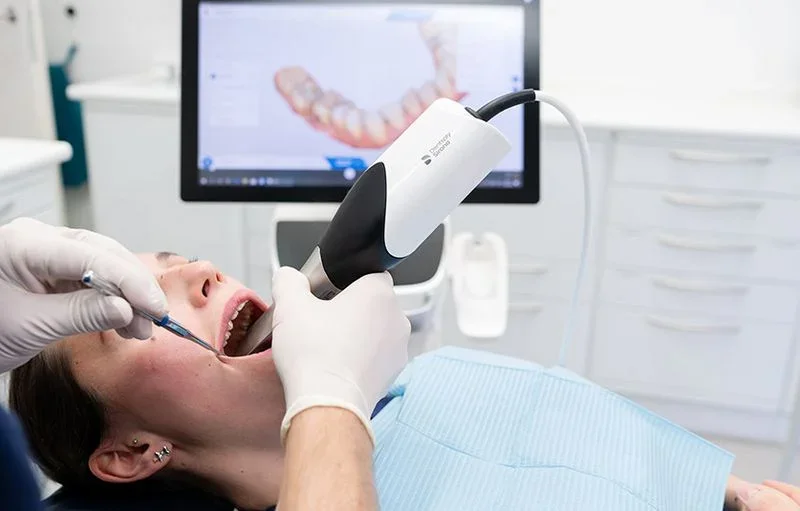
Digital Scanning
An intraoral scanner captures the prepared tooth and surrounding teeth in three dimensions. No impression material and no gagging. Reviews find the record as accurate as a well-taken physical impression, and most patients find it considerably more comfortable.
Custom Design
Specialised software designs your crown to fit the preparation exactly, in correct contact with the teeth beside it and in proper occlusion with the tooth above.
In-House Milling
A solid ceramic block is milled to the design in fifteen to twenty minutes while you wait. The same process makes inlays and onlays for teeth that need less than a full crown.
Cementation
The crown is tried in, adjusted for bite and contact, then permanently cemented with tooth-coloured resin.
How it differs from the two-visit route
One Appointment
The entire process is completed in a single visit rather than spread across two appointments two weeks apart.
No Temporary Crown
Temporaries come loose, feel wrong, and occasionally fall out at inconvenient moments. Same-day treatment eliminates them entirely.
Precise Digital Fit
Digital scanning avoids the distortion that physical impression material introduces, producing a more accurate margin.
Material Options
Zirconia, porcelain, and hybrid materials are all available, chosen for the tooth's position and the forces it takes.
Common questions
Are same-day crowns as durable as traditional ones? +
Yes. The ceramic materials used are equivalent to those in laboratory-fabricated crowns, and the digital fit is typically better.
Can I have one after a root canal on the same day? +
Often, yes. This is one of the strongest arguments for the technology, because a root-treated tooth is vulnerable to fracture until it is crowned.
What if there is decay underneath? +
The decay is removed first and the tooth assessed. If enough sound structure remains, the crown proceeds as planned.
Does insurance cover it? +
Typically around 50 percent after your deductible, though coverage varies by plan. We verify before treatment.
How long the appointment actually takes
Roughly ninety minutes from start to finish for a straightforward case, and the milling itself is fifteen to twenty minutes of that. You wait in the practice while it runs.
Compare that with the conventional route: one appointment to prepare the tooth and take an impression, a temporary crown fitted, the case posted to a laboratory, one to three weeks of waiting, then a second appointment to remove the temporary and fit the final crown. Two visits, two lots of freezing, and a temporary in between that can come loose or leak.
What it is made from
The crown is milled from a solid, factory-made ceramic block. Two materials cover most cases.
- Lithium disilicate is the usual choice where appearance matters most. It is translucent in a way that reads as natural, and strong enough for most positions in the mouth.
- Zirconia is stronger and less translucent. It is the choice for back teeth taking heavy load, and for anyone who grinds.
Because the block was manufactured under controlled conditions, its internal structure is consistent in a way that hand-layered porcelain is not. That is a genuine difference, and it is about consistency rather than about the fit at the margin.
How long they last
Reviews of CAD/CAM ceramic restorations report survival of around 95 percent at three years and beyond. That is the figure worth quoting because it is the one the pooled evidence supports.
Longer-term numbers for chairside milled crowns specifically are less settled. The ten-year data comes from small studies rather than large trials, so a confident ten-year figure for this particular restoration goes further than the evidence does. We would rather tell you that than quote a number we cannot stand behind.
What shortens any crown is fairly consistent: grinding, new decay at the join between crown and tooth, and gum disease undermining the support. The first is the big one, and a guard costs considerably less than a replacement — teeth grinding and night guards.
When a two-visit laboratory crown is still the better choice
Most crowns can be done in a visit. Some should not be, and it is worth knowing which before you assume the faster route is the better one.
- Front teeth where shade matching is demanding. A technician layering porcelain by hand can reproduce subtleties of translucency and internal colour that a single milled block cannot. If you are restoring one upper front tooth next to a natural one, that can be the deciding factor.
- Several units together, or a full arch. Longer spans are a different problem, and a conventional impression is often the more reliable record over distance.
- Deep or bleeding margins. A scanner photographs what it can see. Where a preparation sits below the gum and the field will not stay dry, an impression material that flows can capture what a camera cannot.
Having both routes in one building is the point. The choice gets made on the case rather than on what equipment is in the room — see how the digital workflow works for where the evidence supports each.
What it costs, and what a crown is competing with
A crown is one answer to a damaged tooth, not the only one, and the right answer depends on how much sound tooth is left.
- A filling works while the walls of the tooth are strong enough to carry the chewing load — dental fillings.
- An onlay covers the chewing surface without reducing the whole tooth. It is the middle option and preserves more tooth than a crown.
- A crown covers the tooth completely, and is the honest answer once a wall has broken or after root canal treatment — dental crowns and root canal therapy.
- Extraction and replacement where the tooth cannot be saved. Then the question is a denture, a bridge or an implant, and that decision turns on bone and on cost.
Fees vary with the material and the position of the tooth. You get a written, itemised estimate before treatment begins — financing options if the cost needs spreading.
Common questions
How long does the appointment take?+
About ninety minutes for a straightforward case. The milling itself is fifteen to twenty minutes, and you wait in the practice while it runs.
Is a milled crown as good as one made by a laboratory technician?+
For most positions, yes, and the ceramic block is more consistent internally than hand-layered porcelain. For a single front tooth next to a natural one, a technician layering by hand can match subtleties of colour that a single block cannot, and we will say so.
How long will it last?+
Reviews of CAD/CAM ceramic restorations report around 95 percent survival at three years and beyond. Reliable ten-year figures for chairside milled crowns specifically are not established, so we would rather not quote one.
What is it made of?+
Lithium disilicate where appearance matters most, or zirconia where the tooth takes heavy load or you grind. Both are milled from a solid factory-made block.
Do I still need freezing?+
Yes. The tooth is prepared in the same way as for any crown. What you avoid is the second appointment, the second round of freezing and the temporary in between.
Ready to get started?
Schedule your same-day crown appointment. Call (905) 479-7777.