
Single Tooth Implant in Markham
Replace one missing tooth with an implant and crown — no grinding of healthy neighbours, no removable parts, and a result that looks and feels like your natural tooth.
Request an Implant Consultation
Complimentary · No obligation · Markham office
One missing tooth matters more than you might think.
A single missing tooth can set off a chain of problems. Neighbouring teeth drift into the gap, the opposing tooth over-erupts, and the jawbone beneath the gap begins to resorb without a root to stimulate it. Over time, these changes affect your bite, your appearance, and the health of surrounding teeth.
A dental implant is the only replacement option that addresses the root as well as the crown. The titanium post integrates with the jawbone, preserving bone volume and providing a stable anchor for the custom porcelain crown placed on top.
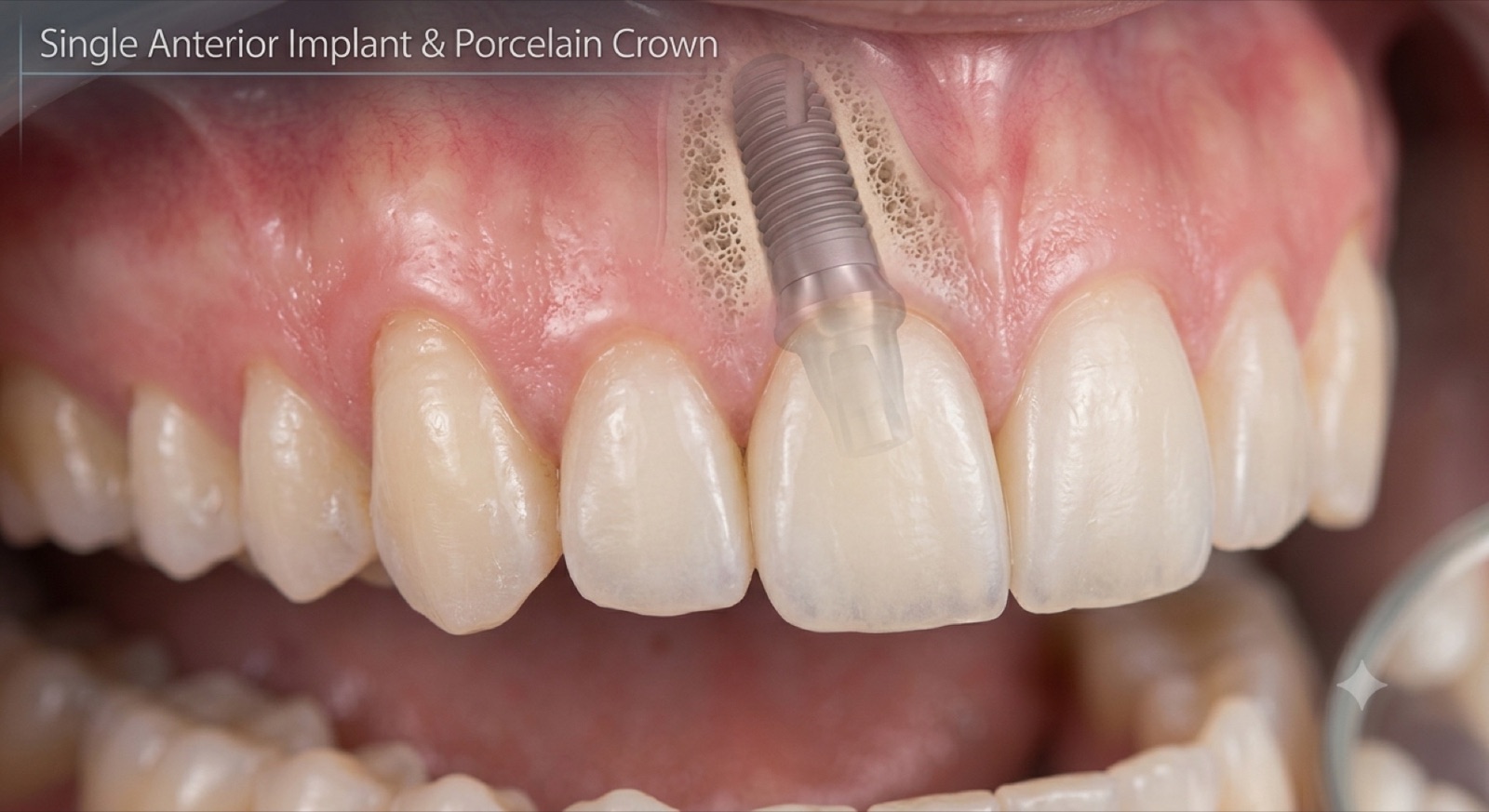
The advantages of a single tooth implant
Healthy teeth untouched
A traditional bridge requires permanently grinding down the two teeth on either side of the gap. An implant stands alone — your healthy neighbours are left completely intact.
Bone preservation
The implant post stimulates the jawbone in a way similar to a natural root, which helps reduce the bone resorption that causes facial changes and makes future treatment more complex.
Fixed in place
The crown is cemented or screwed onto the implant. It does not come out, does not move, and requires no adhesives.
Natural appearance
The porcelain crown is custom-shaded and shaped to match your surrounding teeth. Most patients find it hard to tell apart from a natural tooth.
Easy to clean
Clean an implant crown much the same way as a natural tooth — brush, floss, and attend regular hygiene appointments. No special tools required.
Long-term value
A single tooth implant is designed and planned to be long-lasting; a traditional bridge typically needs replacement after 7–15 years.
What to expect — step by step
Consultation + 3D scan
A complimentary consultation includes a 3D CBCT scan, where appropriate, to assess bone volume at the implant site and confirm you are a suitable candidate.
Implant placement
The titanium implant post is placed into the jawbone under local anaesthetic. IV sedation is available. A healing cap is fitted and the site is left to heal.
Osseointegration
Over 3–6 months the implant fuses with the surrounding bone — a process called osseointegration. A temporary crown may be worn during this period.
Abutment placement
Once integrated, a small connector piece (abutment) is attached to the implant post. This is a minor procedure, often done under local anaesthetic.
Crown placement
Impressions are taken and the final porcelain crown is custom-fabricated, fitted, and adjusted for a precise bite and natural appearance.
What does a single tooth implant cost in Markham?
A single tooth implant (implant post + abutment + crown) typically ranges from $3,500 to $6,000 at Dentistry at Vitality Health. The range reflects differences in anatomy, whether bone grafting is required, and the type of crown material selected.
Your written, itemised quote is provided at your complimentary consultation, after a 3D CBCT scan where one is needed — so you know the full cost before any treatment begins. Financing is available through iFinance Dental with terms up to 60 months.
Ranges are estimates. Exact fees depend on individual anatomy and any preparatory procedures required.
Learn about financing optionsCan the implant go in the same day the tooth comes out?
Sometimes, yes. There are three timings for placing an implant after a tooth is removed, and which one we recommend depends on what we find in the socket and on the scan.
- Immediate placement. The implant goes into the socket on the same day the tooth comes out, with bone graft material packed around it. One surgery, no waiting period, and the gum shape is preserved. It needs an intact socket, enough bone beyond the root tip to hold the implant firmly, and no active infection.
- Early placement. The implant is placed six to eight weeks later, once the gum has healed over but before much bone has been lost. Often chosen when there was infection, or when the gum needs to thicken first, especially at the front of the mouth where appearance matters most.
- Delayed placement. The implant is placed three to six months later, after the socket has filled with bone, usually with socket preservation done at the extraction so the ridge keeps its shape while it heals.
Three things decide the timing: infection (an implant should not be placed into an active infection), bone (there must be enough to hold the implant stable from day one), and aesthetics (a front tooth needs the gum line to heal predictably). All three are assessed on the 3D CBCT scan and at the extraction itself, so the plan can change on the day if the socket is not what we expected.
Where immediate placement is possible we usually fit a temporary crown on the implant the same day, so you leave with a tooth. That is the single-tooth version of Teeth-in-a-day. Whatever the timing, the implant is placed with our computer-guided technique, planned on the scan so it sits exactly where the final crown needs it.
Single Tooth Implant FAQs
Am I a candidate for a single tooth implant?
Most adults with a single missing tooth and adequate jawbone are candidates. Bone grafting can address deficiencies in many cases. Medical conditions affecting healing (uncontrolled diabetes, active cancer treatment, certain medications) may affect candidacy. Where a 3D CBCT scan is appropriate, it will determine your suitability.
How long does the full treatment take?
From implant placement to final crown, treatment typically takes 4–8 months. The longest phase is osseointegration (3–6 months), during which the implant fuses with the bone. A temporary crown can be worn during this period.
Is the procedure painful?
Implant placement is performed under local anaesthetic, so you should feel pressure but not pain during surgery. IV sedation is available for patients who prefer to be deeply relaxed. Post-operative discomfort is typically mild and managed with over-the-counter pain relief.
How long does a single tooth implant last?
A single tooth implant is designed and planned to be long-lasting, and good oral hygiene and regular dental visits help it stay that way. The porcelain crown may eventually need replacement due to normal wear.
Does insurance cover dental implants?
Coverage varies by plan. Some plans cover a portion of the crown or abutment; others exclude implants entirely. Our treatment coordinators will review your benefits and submit a pre-determination to your insurer on request before treatment begins.
Request a complimentary implant consultation
Find out whether a single tooth implant is right for you — with a written quote at no charge, and a 3D CBCT scan where appropriate.
4792 Highway 7 E, Markham, ON L3R 1M8
Request an Implant Consultation
Complimentary · No obligation · Markham office