
Implant Dentistry
Multiple tooth implants
Missing two to five teeth? Implant-supported bridges, individual implants, or a combination — planned around your anatomy rather than a standard template.
More than one tooth missing? Implants remain a highly predictable, long-term option.
When multiple teeth are missing, the options range from a removable partial denture to individual implants or an implant-supported bridge. Implant-based solutions are the only option that replaces the tooth root — preserving the jawbone and helping reduce the bone loss that causes facial changes over time.
The right approach depends on how many teeth are missing, where they are located, and the condition of the surrounding bone. Our team will assess your anatomy with a 3D CBCT scan and recommend the most appropriate solution at your complimentary consultation.
What treatment looks like by gap size
Two Missing Teeth
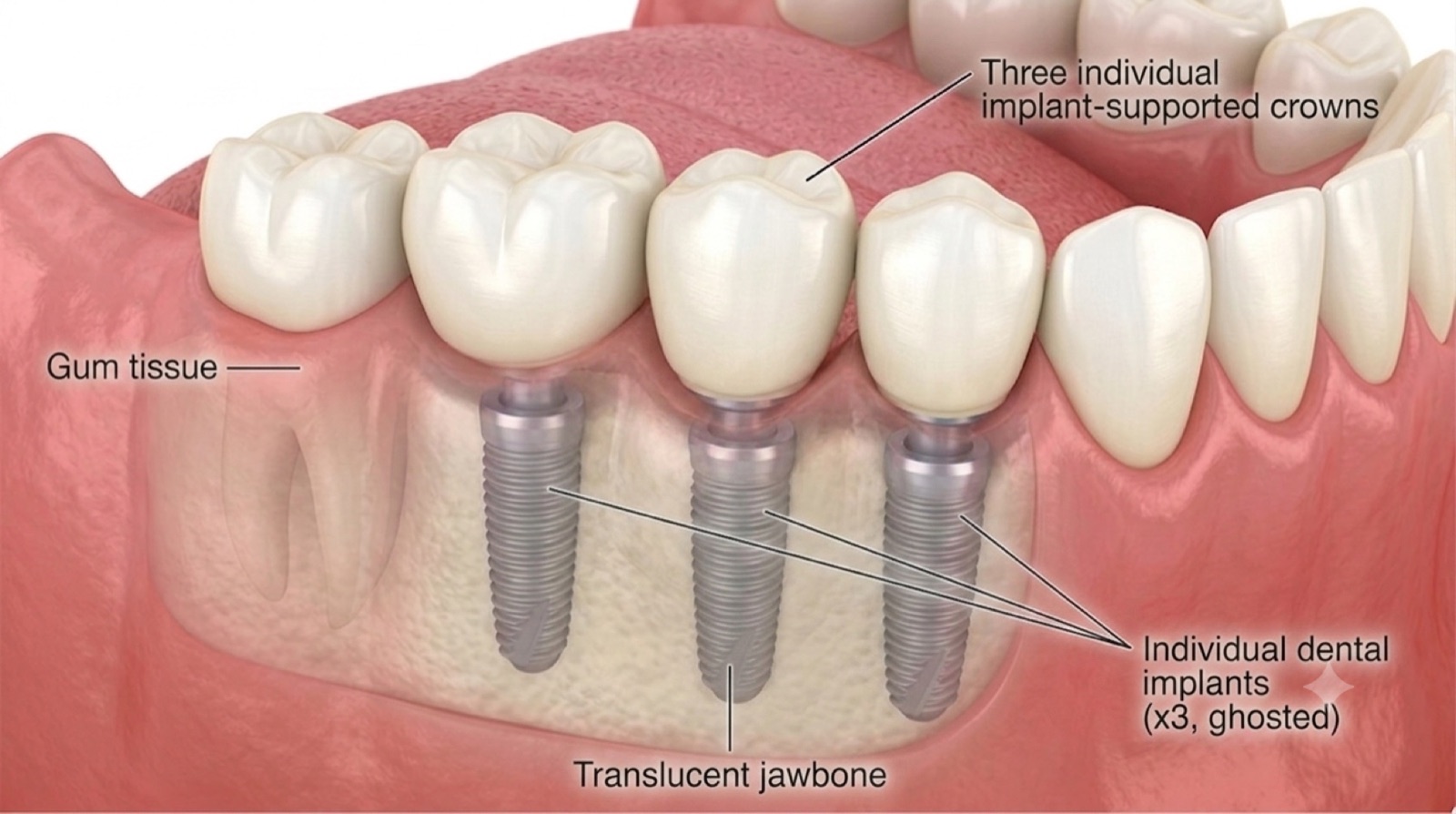
Either an implant-supported bridge on two implants, or two individual implants — the choice depends on bone volume and where the gap sits.
Three Missing Teeth
A two-implant bridge spanning the gap, or three individual implants where bone and spacing allow.
Four Missing Teeth
A minimum of two implants, though three or four is preferred to spread the load and protect long-term stability.
Five Missing Teeth
A minimum of three implants, with four preferred for longevity. Four to five teeth is the practical maximum span for an implant bridge.
Individual implants or implant bridge — which is right for you?
Individual implants for each tooth
Each missing tooth is replaced by its own implant post and crown. This is the most independent solution — each tooth stands alone, making cleaning straightforward and eliminating any reliance on neighbouring teeth. Best when the missing teeth are not adjacent.
Best for: non-adjacent missing teeth or patients who want maximum independence between restorations
Implant-supported bridge
Two implants anchor a fixed bridge that spans the gap, replacing two or more adjacent missing teeth without crowning healthy neighbours. Fewer implants are needed than individual replacements, which can reduce cost and surgical time.
Best for: two or more adjacent missing teeth where fewer implants are preferred
The advantages of implant-based tooth replacement
Bone preservation
Implants stimulate the jawbone in a way similar to natural tooth roots, which helps reduce the bone resorption that occurs under a denture or bridge.
No healthy teeth affected
Unlike a traditional bridge, implants do not require grinding down adjacent healthy teeth to serve as anchors.
Fixed in place
Implant restorations are fixed in place — no removal, no adhesives, no movement during eating or speaking.
Natural look and feel
Each crown is custom-shaded and shaped to match your natural teeth, and the implant integrates with the bone for a stable, natural feel.
Long-term value
Implants are designed and planned to be long-lasting, and proper care helps them stay that way.
Easy to clean
Individual implant crowns are cleaned in much the same way as natural teeth. Implant bridges require a water flosser under the span — simpler than a partial denture.
What to expect — step by step
Consultation + 3D scan
A complimentary consultation includes a 3D CBCT scan, where appropriate, to assess bone volume and determine the optimal number and position of implants.
Treatment planning
Your surgeon maps the exact implant positions in 3D. Any preparatory procedures (extractions, bone grafting) are planned and scheduled.
Implant placement
Implants are placed under local anaesthetic (IV sedation available). Healing caps are fitted and a temporary restoration may be provided.
Osseointegration
Over 3–6 months the implants fuse with the jawbone, creating a stable foundation for the final crowns or bridge.
Final restorations
Impressions are taken and the final crowns or bridge are fabricated, fitted, and adjusted for a precise bite and natural appearance.
What does replacing multiple teeth with implants cost in Markham?
Individual implants (implant post + abutment + crown) typically range from $3,500 to $6,000 per tooth at Dentistry at Vitality Health. An implant-supported bridge replacing two or more adjacent teeth typically ranges from $7,000 to $12,000.
Your written, itemised quote is provided at your complimentary consultation, after a 3D CBCT scan where one is needed. Financing is available through iFinance Dental with terms up to 60 months.
Ranges are estimates. Exact fees depend on individual anatomy and any preparatory procedures required.
Learn about financing optionsMultiple Implants FAQs
How many implants do I need to replace multiple teeth?
It depends on how many teeth are missing and whether they are adjacent. Each non-adjacent missing tooth typically requires its own implant. Two or more adjacent missing teeth can often be replaced with two implants supporting a bridge, reducing the total number of implants needed.
Can all my missing teeth be replaced in one surgery?
In many cases, yes. Multiple implants can be placed in a single surgical appointment. The exact approach depends on the number of implants, bone conditions, and whether any preparatory procedures are needed. Your surgeon will outline the recommended sequence at your consultation.
Is it better to get individual implants or a bridge?
Individual implants offer strong independence between teeth — each tooth stands alone and is cleaned like a natural tooth. A bridge requires fewer implants and may be more cost-effective for adjacent gaps. Your surgeon will recommend the approach best suited to your anatomy and goals.
What if I don’t have enough bone for implants?
Bone grafting can rebuild lost bone volume before implant placement. Our team performs in-house bone grafting, so you do not need a referral to a separate specialist. The 3D CBCT scan will identify whether grafting is needed and the cost will be included in your written treatment plan.
How long does the full treatment take?
From consultation to final crowns, treatment typically takes 6–9 months when osseointegration is required. Same-day or immediate-load options may be available in select cases. Your surgeon will outline the expected timeline at your consultation.
Request a complimentary implant consultation
Find out whether individual implants or an implant bridge is right for your case — with a written quote at no charge, and a 3D CBCT scan where appropriate.
Ontario requires us to say how a dentist is registered. Implant treatment here is provided by Dr. Raj Singh, a general dentist who provides implant services.
4792 Highway 7 E, Markham, ON L3R 1M8
Request an Implant Consultation
Complimentary · No obligation · Markham office
Ready to explore dental implants?
Book a consultation and we will map exactly what your gap needs. Call (905) 479-7777.