
Implant Surgery & Support
Socket preservation: protecting the bone when a tooth comes out
The bone around a tooth starts to shrink the moment the tooth is gone. A small graft placed in the empty socket the same day slows that loss and keeps your options open.
Reviewed by Dr. Claudio Tocchio, Oral & Maxillofacial Surgeon, Dentistry at Vitality Health
Socket preservation is a small bone graft placed into the socket immediately after a tooth is removed. It fills the space the root left behind, so the jawbone heals with more of its width and height instead of collapsing inward. It is done in the same appointment as the extraction, adds only a few minutes, and makes a future dental implant simpler and more predictable.
If there is any chance you will want to replace the tooth with an implant later, this is the moment to protect the site. Rebuilding bone after it has been lost is possible, but it is a bigger procedure, takes longer to heal and costs more than preserving what is already there.
This page explains what happens to bone after an extraction, who benefits from socket preservation, how the procedure works, how long healing takes and what it costs. Our extractions and grafting are carried out by Dr. Claudio Tocchio, our oral and maxillofacial surgeon, and by our implant dentists.
What happens to the jawbone after a tooth is removed?
The thin bone that surrounds a tooth root exists only to hold that tooth. Once the root is gone, the body begins to remove it. Most of the loss happens in the first few months, and it is not small. A systematic review of human studies found that the ridge lost 29 to 63 per cent of its width and 11 to 22 per cent of its height within six months of an extraction, with the largest changes in the first three months (Tan et al., 2012).
The outer (cheek-side) wall of the socket is the thinnest and shrinks the most, so the ridge does not just get shorter; it collapses inward. An implant placed into a collapsed ridge may need a separate bone graft first, may end up positioned further in than the neighbouring teeth, or may leave a visible dip in the gum line at the front of the mouth. Read more about jawbone loss and why it matters.
What is socket preservation?
After the tooth is removed, the socket is cleaned and filled with a bone graft material. The material acts as a scaffold. Your own bone cells grow into it over the following months and gradually replace it with natural bone. A small collagen membrane or plug is usually placed over the top to hold the graft in place and keep gum tissue from growing down into the socket while bone forms.
The graft material is most often allograft (sterilized, processed human donor bone) or xenograft (processed bovine bone), sometimes mixed with a synthetic material. All are screened and processed to be safe, and all have decades of use. We choose based on the site and the timing of the planned implant. Our bone grafting types and materials page explains the options in more detail.
Who benefits from socket preservation?
- Anyone who may want an implant later. Even if you are not sure yet. Preserving the site costs far less than rebuilding it, and it leaves the decision open.
- Front teeth, where the shape of the gum and bone shows every time you smile.
- Sockets with a thin or damaged outer wall, for example after an infection, a fracture or a long-standing failed root canal.
- Sites where the implant will be delayed by months, for healing, finances or scheduling, so the bone does not shrink while you wait.
- Future denture wearers, because a fuller ridge gives a denture a better foundation to sit on.
Socket preservation is not always needed. If an implant can be placed on the same day as the extraction (an immediate implant), the implant itself fills the socket, often with graft material packed around it. And if you have firmly decided against replacing the tooth and it is a back tooth, the site can simply be left to heal. We will tell you plainly which applies.
What does the procedure involve, step by step?
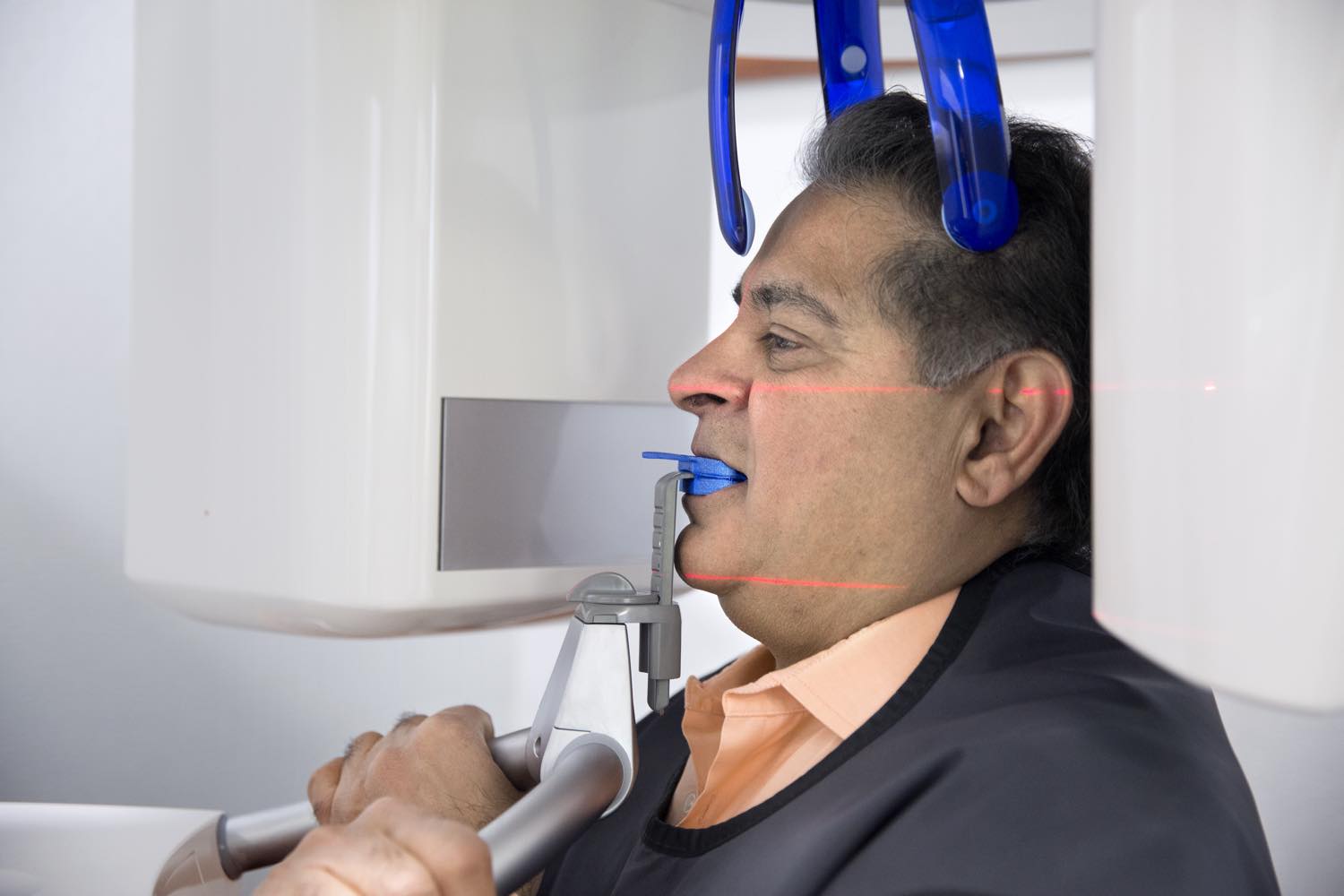
- Planning. A 3D CBCT scan (a low-dose cone-beam CT that shows bone in three dimensions) tells us how thick the socket walls are and where the future implant would go.
- Freezing. The area is fully numbed with local anaesthetic. Sedation is available if you would rather not be aware of the procedure.
- Gentle removal of the tooth. See the next section on atraumatic technique.
- Cleaning the socket. Any infected tissue is removed so the graft has a healthy base.
- Placing the graft. The material is packed gently to the level of the surrounding bone.
- Covering it. A collagen membrane or plug is placed over the graft and held with a few dissolving stitches.
From the patient's side, socket preservation feels like a normal extraction with a couple of stitches. It adds roughly ten to fifteen minutes.
How long until the implant can be placed?
Most grafted sockets are ready for an implant in three to six months. Front teeth and larger molar sockets tend to sit at the longer end. We confirm with a follow-up CBCT scan that the new bone is dense enough before scheduling the implant.
In the meantime you can wear a temporary tooth if the gap shows. Options include a small removable flipper, a bonded temporary attached to the neighbouring teeth, or, for several missing teeth, a temporary partial denture.
Once healed, the implant is placed with our computer-guided technique, planned on the scan so it goes exactly where the bone is. See single tooth implants for what that stage involves.
What is an atraumatic extraction, and why does it matter?
Atraumatic means “gentle”: removing a tooth in a way that protects the thin socket walls rather than levering against them. The bone lost during a rough extraction cannot be grafted back in the same way, so how the tooth comes out matters as much as what goes in afterwards.
In practice this means loosening the tooth with fine instruments placed between the root and the bone, rather than rocking it with forceps; sectioning a multi-rooted molar into pieces so each root comes out on its own; and avoiding pressure on the outer wall. It takes a little longer. It is worth it.
Every extraction in our practice is planned with the future in mind, whether or not you have decided on an implant. Read more about simple and surgical extractions.
What does socket preservation cost?
The fee depends on the size of the socket, the graft material and whether a membrane is needed. As a guide, socket preservation in Ontario typically falls between about $500 and $1,500 per site, in addition to the extraction fee. Larger grafts to rebuild a ridge that has already collapsed cost several times more, which is the main argument for preserving the site at the outset.
Fees vary; we provide a written estimate before treatment. Many dental plans cover part of the cost of extractions and some cover grafting; we will check your coverage and submit a pre-determination if you wish. The Canadian Dental Care Plan covers extractions but does not cover implant-related procedures.
Common questions
Does socket preservation hurt?+
No more than the extraction itself. The area is fully numbed, and afterwards most people describe mild soreness for two to three days that is controlled with over-the-counter pain relief. The graft does not add to the discomfort in any noticeable way.
Where does the graft material come from, and is it safe?+
Most often from a tissue bank (processed, sterilized human donor bone) or from processed bovine bone. Both are regulated by Health Canada, have been used for decades, and are gradually replaced by your own bone as the site heals. Synthetic materials are also available if you prefer.
What if I never get an implant?+
You still keep more of your jawbone, which supports the neighbouring teeth, keeps the gum line even, and gives a bridge or denture a better foundation. The graft simply becomes part of your own bone.
Can I skip the graft and just wait?+
You can, but the bone will shrink, particularly in the first three months. If you later decide on an implant, you may then need a larger graft that takes longer to heal and costs more. Preserving the socket at the time of extraction is the simpler path.
How should I look after the site afterwards?+
Avoid disturbing the area for the first few days: no rinsing hard, no straws, no smoking, soft foods, and gentle salt-water rinses from the second day. Do not be alarmed if you notice a few small granules of graft material; that is normal. Our extraction aftercare guide covers each day in detail.
Sources: Tan WL, Wong TL, Wong MC, Lang NP. A systematic review of post-extractional alveolar hard and soft tissue dimensional changes in humans. Clin Oral Implants Res 2012;23(Suppl 5):1–21 · Government of Canada, Canadian Dental Care Plan: Dental Benefits Guide
Facing an extraction?
Ask us about protecting the site before the tooth comes out. A free implant consultation includes a 3D scan and a written plan. Call (905) 479-7777.