
Can gum disease be reversed? The honest answer depends on one thing
Gingivitis reverses completely. Periodontitis does not. The difference between them is whether bone has been lost — and that is not something you can judge by looking.
If you have been told you have gum disease, the first thing you probably wanted to know is whether you can undo it. It is a fair question, and most of what you will read online answers it badly — either a flat yes, which is not true for everyone, or a frightening no, which is not true either.
The honest answer turns on one thing: whether you have lost bone yet. That single fact separates a condition that reverses completely from one that can be stopped but not rewound. It is also something you cannot judge for yourself, because the early stages of both feel much the same.
Gingivitis: yes, this one genuinely reverses
Gingivitis is inflammation of the gum tissue only. The gums are red, a little puffy, and they bleed when you brush or floss. Nothing underneath has been damaged.
Remove the plaque and tartar that are causing the irritation, keep them off, and the tissue returns to normal. Not improved — normal. The 2018 international case definitions published by Fan and Caton in the Journal of Periodontology describe gingivitis specifically as a reversible condition, and that is not a hedge. It resolves.
This matters because bleeding gums are common and easy to dismiss. Gingivitis does not hurt, so most people who have it do not know they do — a bit of pink in the sink gets written off as brushing too hard.
Periodontitis: this one stops, it does not rewind
If the inflammation goes on long enough, it stops being a gum problem and becomes a bone problem. The body begins breaking down the bone that holds the tooth in its socket. Once that bone is gone, it does not grow back on its own.
This is the point most articles skip, and it is the one that actually changes what you should do. Treatment for periodontitis is not a repair. It is a halt. A good outcome is a mouth where the disease is no longer active and the bone you still have stays where it is — sometimes for the rest of your life. That is a genuinely good outcome. It is just not the same as reversal.
What treatment cannot do
We would rather say this plainly than have you discover it later:
- It will not regrow lost bone. There are grafting procedures that can rebuild bone in specific, limited situations, but they are a separate decision and they do not apply to most cases.
- It will not put receded gums back. If your teeth look longer than they used to, treating the disease stops the recession getting worse. It does not restore what has gone.
- It will not hold on its own. Periodontitis is a managed condition, like blood pressure. Treatment resets it; upkeep is what keeps it reset.
- It will not tighten a tooth that has become loose from severe bone loss. Some improve as the inflammation settles. Some do not.
How we tell which one you have
Two things, neither of them dramatic. We measure the space between the gum and the tooth with a small probe, in millimetres, at several points around each tooth. And we look at X-rays, because bone level is something you can see on a radiograph and cannot see by looking in a mirror.
Healthy readings sit at about one to three millimetres and do not bleed. Deeper readings, bleeding, and bone loss visible on the X-ray together point to periodontitis. It takes about fifteen minutes, and you will hear us calling out numbers — that is the charting, and you are welcome to ask what they mean as we go.
What actually happens at the appointment
We start non-surgically, and in most cases we stay there. The European Federation of Periodontology's 2020 treatment guideline, led by Sanz and colleagues in the Journal of Clinical Periodontology, sets out a stepwise approach: control the causes first, treat non-surgically, and only consider surgery for sites that have not responded.
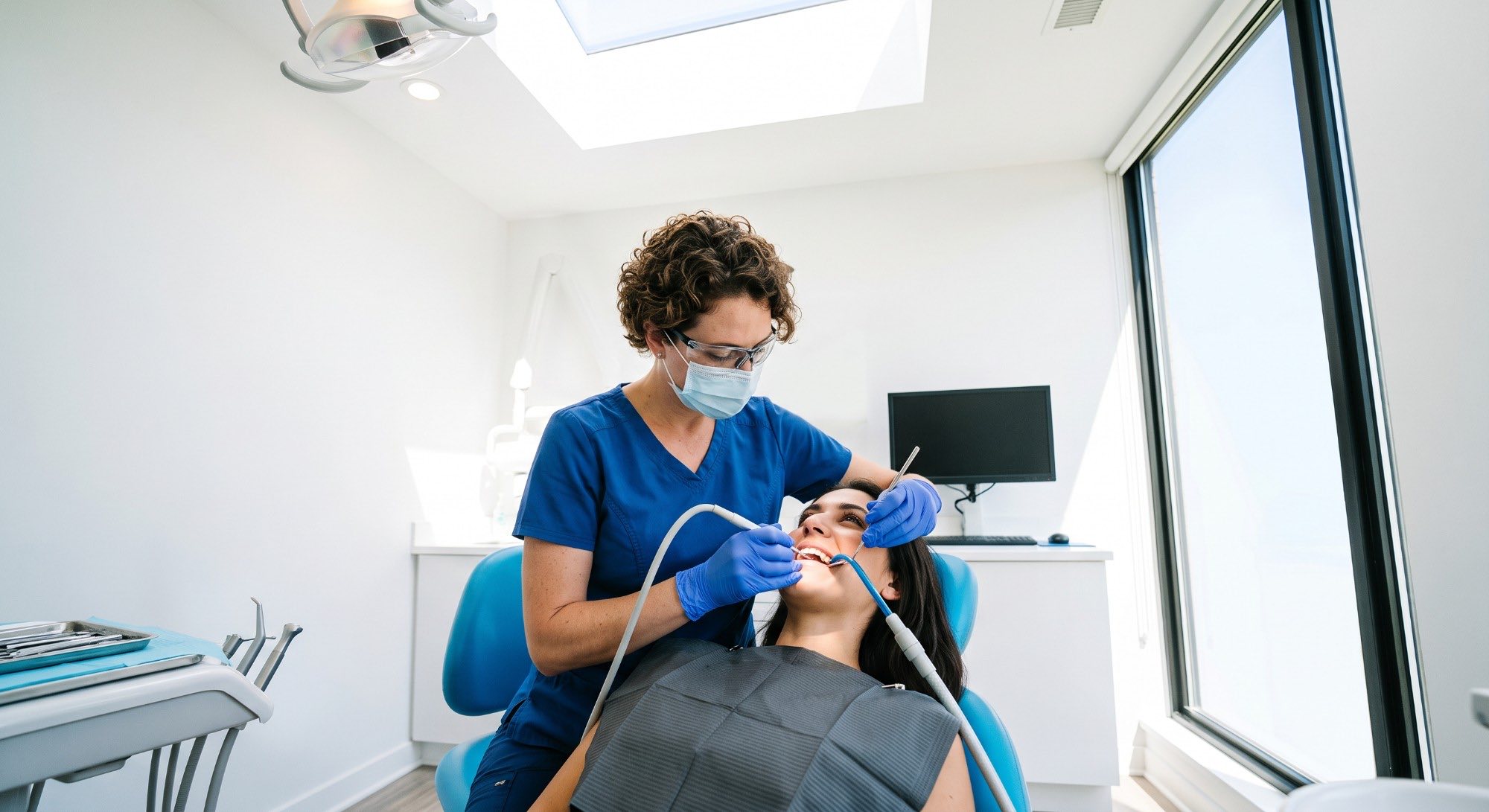
In practice that means cleaning the root surfaces below the gumline properly, usually with the area frozen so you are comfortable, over one or more visits depending on how much there is to do. It is thorough rather than painful. Most people describe the days afterwards as tender rather than sore.
Then we re-measure, usually six to eight weeks later. Those second numbers are the ones that matter, because they tell us whether the tissue has responded — and they are also, frankly, the most satisfying part of the process to show someone.
You can read more about that course of treatment on our periodontal treatment page, and about the condition itself on our gum disease page.
Why every three months instead of six
Once periodontitis has been treated, the cleaning interval usually shortens. This is not upselling, and it is worth understanding why.
The bacteria that cause the problem re-establish themselves in treated pockets over roughly twelve weeks. A six-month interval gives them two full cycles to get going again between visits. Three months interrupts that. It is a different appointment from a routine cleaning, with a different purpose, and we explain the distinction on our periodontal maintenance page.
A 2018 Cochrane review led by Lamont found that for generally healthy adults, routine six-month scaling makes little difference to gum health. That finding is often quoted as evidence that cleanings do not matter. It is worth reading carefully: it looked at people without periodontitis. For someone who has been treated for it, the interval is doing a specific job.
What you do at home is most of it
We see you for an hour every few months. You are in there twice a day. Brushing along the gumline rather than across the teeth, and cleaning between them daily with floss or small brushes, does more for the outcome than anything that happens in our chair.
If your gums bleed when you start doing this properly, that is usually inflammation rather than damage, and it typically settles within a week or two. If it does not, tell us — that is worth looking at rather than pushing through.
So: can it be reversed?
If it is gingivitis, yes, completely, and usually faster than you would expect. If bone has been lost, no — but it can be stopped, and stopping it early is the difference between keeping your teeth and replacing them.
Either way, the thing that decides it is how much has already happened, which is why the answer starts with an examination rather than an article. If your gums bleed, or you have been told you have pockets, it is worth having a look at the actual numbers.
Common questions
Is bleeding when I brush normal?
No, though it is common. Healthy gums do not bleed when brushed or flossed. Bleeding usually means inflammation from plaque at the gumline. If it is new, it is worth having checked rather than waiting to see whether it settles.
Does gum disease treatment hurt?
Non-surgical treatment is done with the area frozen, so you should not feel the cleaning itself. Most people describe the following day or two as tender rather than painful, and manage with an ordinary over-the-counter painkiller.
How long before I know whether it worked?
We re-measure about six to eight weeks afterwards. Tissue needs that long to settle, and comparing those numbers with the first set is how we judge whether the treatment has done its job.
If I cannot regrow the bone, what is the point of treating it?
To keep the bone you still have. Untreated periodontitis keeps taking bone until teeth loosen and are lost. Treated and maintained, it can stay stable for decades.

Free Dental Implant Seminar — No Obligation, No Pressure
"Everything You Need to Know About Today's Dental Implant Treatments" — held monthly at our Markham clinic.
Explore Topics
Written by
Dentistry at Vitality Health
Content creator and writer sharing insights and stories.