
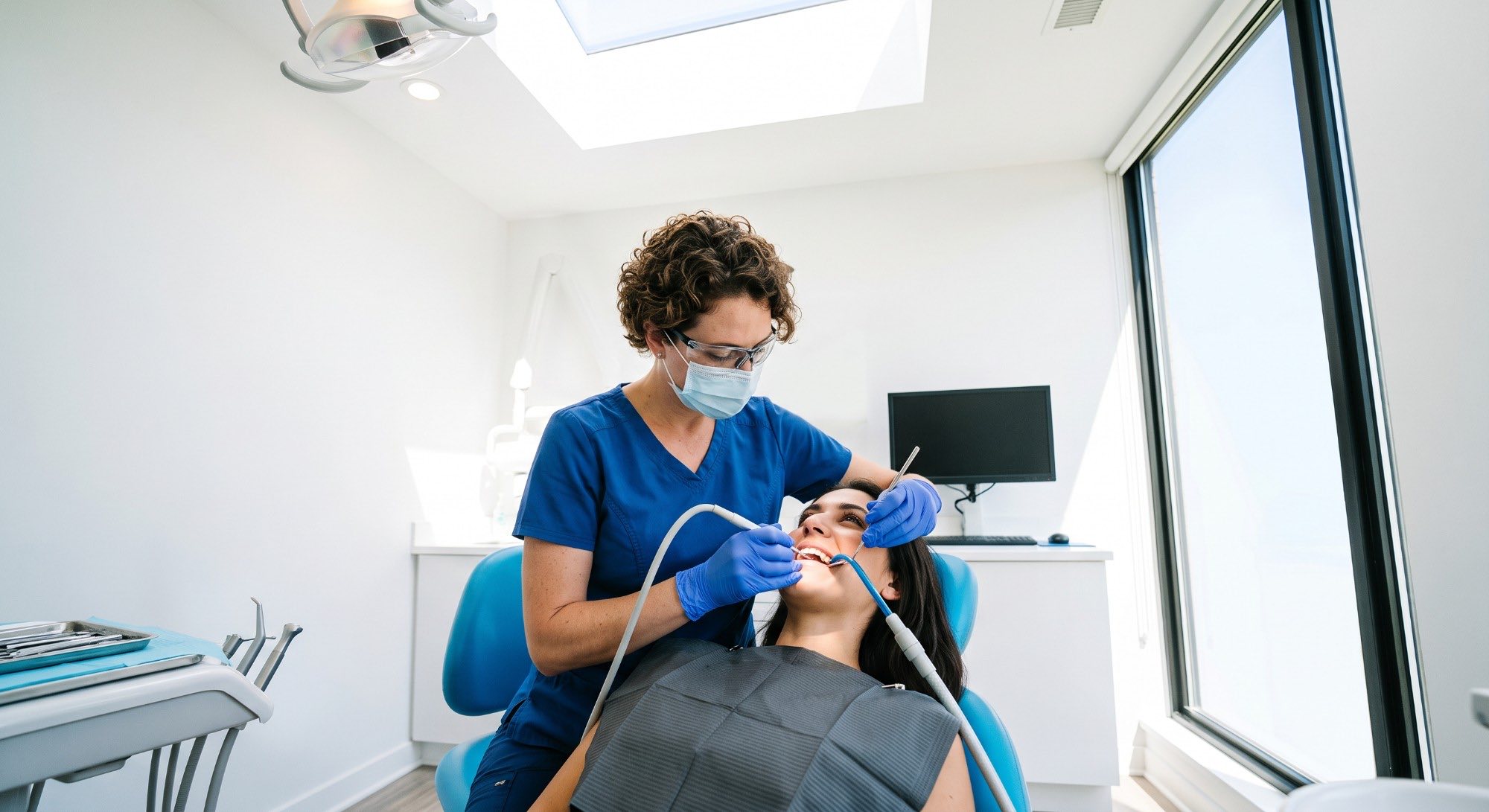
Our Services
Comprehensive exams & professional cleanings
The foundation of lifelong oral health. Regular exams catch problems early, when they are easiest and least expensive to treat.
What your comprehensive exam includes
Visual Assessment
Every tooth surface inspected for cavities, cracks, and failing restorations. Wear patterns indicating grinding or erosion are identified, palpation detects fractures and loose work, and everything is compared against previous exams to track change over time.
Digital X-rays
Bitewings and full-mouth films reveal cavities between teeth and beneath existing restorations, and show bone-level problems. CBCT scanning visualises complex anatomy in 3D. Digital sensors need substantially less radiation than the film they replaced, and we take the smallest number of images that will answer the question.
Gum Screening
Pocket depths measured around every tooth to assess bone loss. Bleeding indicates active disease. Recession and other changes are documented, and tracking over time is what guides treatment decisions.
Oral Cancer Screening
Visual and tactile inspection of all soft tissues to identify suspicious lesions. Oral cancer found early has a far better outlook than oral cancer found late, which is the entire argument for looking at every visit.
Bite Analysis
How your upper and lower teeth meet, assessed for malocclusion. Jaw movement is checked for TMJ problems, and bite discrepancies causing trauma are identified and corrected.
Professional Cleaning
Removal of subgingival tartar that harbours disease-causing bacteria, root scaling where surfaces are exposed, and polishing to reduce staining and bacterial colonisation.
Why it matters more than it sounds
Early detection: a small cavity is a straightforward, inexpensive filling. The same cavity ignored becomes a root canal, a crown, or an extraction.
Cost savings: prevention is consistently cheaper than treatment. Regular cleanings and early intervention prevent the expensive procedures entirely rather than delaying them.
Systemic health: gum disease and diabetes each make the other harder to control, and an exam sometimes picks up the first sign of something that has nothing to do with teeth — a dry mouth from a new medication, an ulcer that has not healed.
How often do you actually need to come in?
Most people have been told every six months, and most people have never been told why. The honest answer is that the right interval depends on your mouth, and for a good number of adults it is longer than six months.
Two large pieces of work sit behind that. A Cochrane review in 2018 pooled trials of routine scaling and polishing in adults who attended regularly and did not have severe gum disease. Over two to three years it found little or no difference in gum inflammation, pocket depths or quality of life between people on a scheduled cleaning and people on none. Scheduled cleaning did reduce tartar, and six-monthly reduced it more than yearly, though the reviewers were clear that the clinical importance of that difference is unknown.
The INTERVAL trial then followed adults in general practice for four years on six-monthly, risk-based, or two-yearly check-ups. Among those eligible for the longer interval, it found no evidence of a difference in oral health. It also found that patients value frequent check-ups and are willing to pay for them, which is worth saying out loud: this is not only a clinical decision.
So we set the interval from your risk and revisit it at every exam rather than defaulting to the calendar. What pushes the interval shorter:
- A history of gum disease, which is the big one — see the next section.
- Smoking, or vaping.
- Diabetes, particularly when blood sugar has been hard to control.
- A dry mouth, whether from medication, radiotherapy or a condition like Sjögren's. Saliva is most of your natural defence against decay.
- A run of new cavities, or a mouth with a lot of existing fillings and crowns, because the margins of old work are where decay restarts.
- Braces, a retainer or a partial denture — anything that holds plaque.
- Difficulty cleaning between the teeth, for any reason, including arthritis or reduced dexterity.
- Pregnancy, which changes how gums respond to the same amount of plaque. More on dental care during pregnancy.
And what allows it to be longer: healthy gums that do not bleed, no new decay over several years, no dry mouth, no smoking, and cleaning between the teeth that is actually happening rather than intended.
One caveat on those two studies, because it matters. Both looked at adults who were already attending and did not have advanced gum disease. If you have had periodontitis, none of the above applies to you, and the reason is biological rather than administrative.
If you have had gum disease
Periodontal maintenance is a different appointment
Everything above assumes healthy gums. Once periodontitis has been treated, the care that follows is not a routine cleaning under another name. The gums are measured and charted at every visit, the cleaning reaches into the pockets that remain, and the interval is usually three months rather than six — because the bacteria below the gum line are measurably back to pre-treatment levels by about twelve weeks.
Just over a third of Canadian adults now have pocketing of 4 mm or deeper, so this is not a rare situation. It has its own page, covering what happens at each visit, what the evidence says about keeping it up, and how the interval is set.
Read about periodontal maintenanceX-rays, and when we take them
Radiographs are taken when there is a clinical reason to take them, not on a schedule. In Ontario that is the law rather than a policy of ours — the Healing Arts Radiation Protection Act permits imaging only where it is clinically indicated for that patient. It is also why you will never see us advertise a free X-ray.
In practice, the interval follows the same logic as the recall. Someone with a history of decay between the teeth needs bitewings more often than someone who has not had a new cavity in fifteen years, because the films are there to answer a question. If there is no question, there is no film. We will tell you what we are looking for before we take one.
What happens between appointments counts for more
Two cleanings a year is about ninety minutes. You brush for roughly thirty hours in the same period. The arithmetic is not subtle, and it is the reason the coaching part of the appointment is not filler.
The part most people skip is between the teeth, which is also where gum disease starts and where a toothbrush has never reached. If floss has never worked for you, say so — interdental brushes are easier for most adults and more effective where the gaps have opened up, and the size matters more than the brand. More on looking after your teeth at home.
What a check-up costs
We charge the Ontario Dental Association's suggested fees for examinations, X-rays and cleanings. They are the same for every patient, with or without insurance, and most private plans cover preventive care at or close to 100%.
An examination is $45 at a regular check-up. As a new patient it is $94 for a limited examination or $191 for a complete one, and an emergency examination is $56 to $162, depending on what it involves.
X-rays, when they are needed, are $43 for a single image, $50 for two bitewings, $64 for four bitewings and $86 for a panoramic X-ray.
Cleaning is charged by time, in 15-minute units. Scaling is $75 for one unit, $144 for two, $202 for three and $264 for four, and polishing is $37 a unit. Fluoride varnish is $39. Sealants are $40 for the first tooth and $23 for each additional tooth in the same quarter of the mouth.
As an example, a check-up with an examination, two bitewing X-rays, two units of scaling and one of polishing comes to $276. How many units you need depends on how much there is to clean.
Common questions
Do I really need a cleaning every six months?+
Possibly not. For adults with healthy gums, no new decay and none of the risk factors, the trials have not shown that six-monthly beats a longer interval on any outcome that matters. What we do instead is set the interval from your risk at each exam. If you have had gum disease, the answer changes completely and the interval is usually shorter than six months, not longer.
Do I need X-rays at every visit?+
No, and you should not have them at every visit. Ontario's Healing Arts Radiation Protection Act allows radiographs only where they are clinically indicated for you, so the interval depends on your history — more often if you have had decay between the teeth, much less often if you have not. We will say what we are looking for before taking one.
Does insurance cover periodontal maintenance?+
Most plans cover it, often under a different code and sometimes with a different annual limit from a routine cleaning, which is why the coverage can look confusing on a statement. We submit electronically and will go through what your plan pays before you commit to a schedule. We also accept the Canadian Dental Care Plan. More on insurance and financing.
Ready to get started?
Book your exam and cleaning. Call (905) 479-7777.