
Our Services
Dentures and partial dentures
A denture replaces missing teeth with a removable set you can take out to clean. Here is how they are made, how to live with them well, and what to do when they start to loosen.
Reviewed by Dr. Raj Singh, Implant Dentist, Dentistry at Vitality Health
A denture is a removable set of replacement teeth. A complete denture replaces all the teeth in the upper or lower jaw. A partial denture fills in gaps when you still have some healthy teeth. Both are made to fit your mouth from a scan or impression, and both need a few weeks of adjustment to feel natural.
Dentures have been around for a long time, and they are still the right choice for many people. They are the least invasive way to replace several teeth, they do not need surgery, and they are covered by the Canadian Dental Care Plan (CDCP) for people who qualify. This page explains what to expect, in plain language, so you can decide with your eyes open.
Dentures also have limits. The jawbone under a denture keeps shrinking over the years, so every denture loosens eventually. We explain why that happens and what your options are when it does, including the point where adding implants can make a denture far more stable.
What is a denture, and what are the types?
A complete denture replaces every tooth in one jaw. It rests on the gums and, in the upper jaw, is held in place partly by suction against the roof of the mouth. A lower complete denture has less to hold onto, which is why lower dentures tend to move more.
A partial denture replaces some teeth and clips onto the natural teeth around the gap. There are two main kinds:
- Acrylic partial. Made of pink plastic with wire clasps. Lower cost and quicker to make, but bulkier and less durable. Often used as a temporary or transitional denture.
- Metal-framework partial. A thin cast metal base (usually a cobalt-chromium alloy) with acrylic gums and teeth. Slimmer, stronger and more stable, and designed to last longer.
Which type suits you depends on how many teeth are missing, where they are, and how healthy the remaining teeth and gums are. We will tell you plainly which we recommend and why.
How are dentures made, step by step?
- Examination and planning. We check your gums, any remaining teeth and your jawbone, usually with x-rays. Teeth that cannot be saved are scheduled for removal.
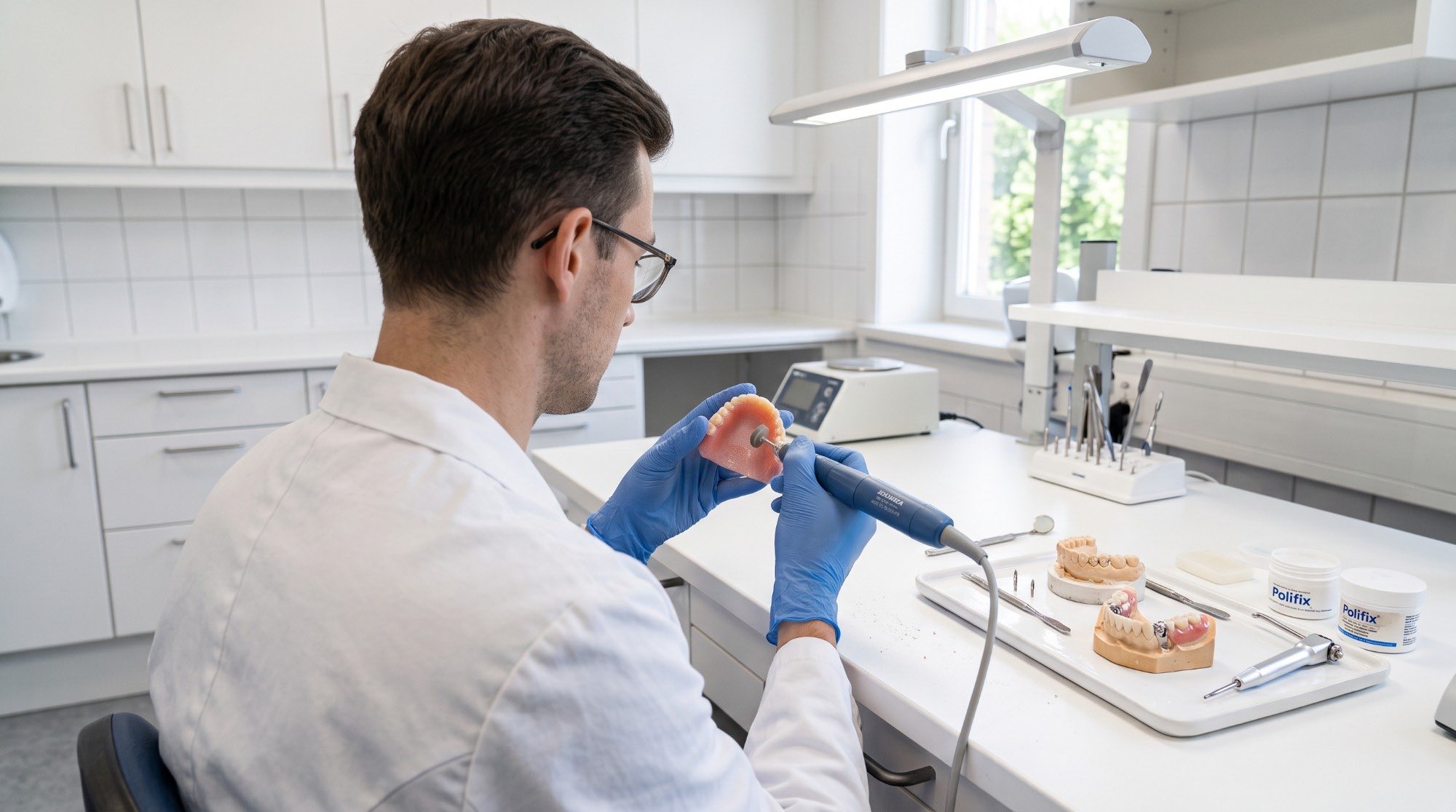
- Impressions or a digital scan. We record the exact shape of your gums and jaws. Our in-house digital lab lets us scan instead of using trays of impression material for many patients.
- Bite records. We measure how your jaws meet and how tall your teeth should be, so the denture supports your face and lets you chew comfortably.
- Try-in. The teeth are set in wax so you can see the shape, shade and position before anything is finalized. This is the moment to ask for changes.
- Finishing and fitting. The denture is processed in hard acrylic, polished and fitted. We adjust any pressure spots on the day and at follow-up visits.
Most dentures take four to six visits over several weeks. Because our lab is in the building, adjustments and small repairs are usually faster than sending work out.
What is an immediate denture?
An immediate denture is made before your remaining teeth are removed and placed the same day they come out. You never go without teeth. The trade-off is that the gums shrink a great deal as they heal, so an immediate denture needs relining (adding new material to the fitting surface) after a few months, and is often replaced with a conventional denture within the first year or two.
Under the CDCP, an immediate or transitional denture is covered once per arch (upper or lower jaw) in a lifetime, and a standard complete denture once per arch every eight years. We will explain how these rules fit your situation before we start.
How long does it take to get used to new dentures?
Plan on two to four weeks of adjustment. In the first days your mouth will feel full, you may salivate more, and speech can sound different. All of that settles as your tongue and cheeks learn the new shape.
- Eating. Start with soft foods cut into small pieces, chew on both sides at once, and avoid very hard or sticky foods at first.
- Speaking. Reading aloud for a few minutes a day speeds things up. Words with 's' and 'f' sounds are the usual sticking points.
- Sore spots. Small pressure points are normal in the first two weeks. Do not try to adjust the denture yourself. We can relieve a sore spot in minutes at a follow-up visit.
If a denture is still painful or moving after a month, tell us. A denture that never settles usually has a fit problem we can fix.
How do I care for dentures?
Clean daily
Brush the denture every day with a soft denture brush and a denture cleaner or mild soap. Regular toothpaste is too abrasive and scratches the acrylic, which lets stains and bacteria build up.
Rinse after meals
Take the denture out and rinse it after eating when you can. Rinse your mouth too, and brush your gums, tongue and any natural teeth with a soft brush.
Take it out at night
Give your gums a rest for at least six to eight hours a day, usually overnight. Sleeping in a denture raises the risk of gum irritation and fungal infection.
Store it wet
Keep the denture in water or a cleaning solution when it is out of your mouth. Acrylic that dries out can change shape. Never use hot water, which warps it.
Handle with care
Fill the sink with water or lay a towel down while cleaning. A denture dropped onto a hard surface can crack. If it does, bring it in; do not use household glue.
Keep your check-ups
Even with no natural teeth, we need to check your gums, your bite and your mouth for changes, including an oral cancer screening, at least once a year.
Why do dentures loosen over time?
The jawbone is kept strong by the roots of your teeth. Once teeth are gone, the bone that held them slowly shrinks. This is called resorption. A denture sitting on that bone loses its fit as the ridge underneath gets smaller. It starts to rock, trap food, and rub.
A reline adds a new layer of material to the fitting surface so the denture matches the current shape of your gums. It restores fit for a time, but it does not stop the bone from shrinking. Most people need a reline every one to two years and a new denture every five to eight years. Under the CDCP, a reline is covered once per arch every two years.
Over many years the loss of bone can change the shape of the lower face, which is why we talk about jawbone loss and facial collapse with long-term denture wearers. The only treatment that slows this process is a dental implant, because an implant loads the bone the way a tooth root does.
When do implants make a denture better?
If your denture moves when you eat or speak, if you have had several relines, or if you find yourself avoiding foods you enjoy, it is worth knowing about implant-supported options. Two to four implants can hold a lower denture firmly in place with snap-in attachments, and the denture still comes out for cleaning. A fixed, non-removable implant bridge is another option for people who want to be finished with a removable denture altogether.
Implants are not for everyone, and the CDCP does not cover them. We are not telling you to choose implants. We are saying you should know the option exists, so the decision is yours. Read more at implant-supported dentures and implants compared with dentures.
What do dentures cost?
The fee depends on the type of denture, the materials, and whether teeth need to be removed first. As a guide, typical fees in Ontario fall in these ranges:
| Denture | Typical Ontario range (per arch) |
|---|---|
| Complete denture | About $1,300 to $3,500 |
| Acrylic partial denture | About $700 to $1,800 |
| Metal-framework partial denture | About $1,200 to $3,500 |
| Reline of an existing denture | About $250 to $600 |
Fees vary; we provide a written estimate before treatment so you know the full figure in advance. Extractions, x-rays and any implant work are separate.
If you have a CDCP card, complete and partial dentures are covered services. Partial dentures need preauthorization, which means the plan must approve them before we start; standard complete dentures do not. Your share of the fee depends on your family net income tier. Learn more on our CDCP information page, and check the current Dental Benefits Guide on canada.ca, because the rules are updated each year.
Common questions
How long do dentures last?+
Most dentures last five to eight years before the fit, the teeth or the acrylic need replacing. Relines in between help keep the fit. How long yours lasts depends mainly on how quickly your jawbone changes and how well the denture is cared for.
Do I have to take my dentures out at night?+
Yes, in most cases. Your gums need a rest, and sleeping in a denture raises the risk of irritation and fungal infection under the plate. If you have a reason to keep them in, talk to us about a cleaning routine that makes this safer.
Can I eat normally with dentures?+
Most people return to a broad diet within a few weeks. Very hard, sticky or chewy foods stay difficult with a complete denture, especially a lower one, because there is nothing holding it down when you bite. Implants change this, which is one reason people ask about them.
Does the CDCP cover dentures?+
Yes. Complete and partial dentures are covered services under the Canadian Dental Care Plan for eligible people, with frequency limits and, for partial dentures, preauthorization. Relines and repairs are also covered within limits. Implant-supported dentures are not covered.
What is the difference between a denture and a bridge?+
A denture is removable. A bridge is fixed in place and is held by crowns on the teeth beside the gap, or by implants. Bridges suit small gaps with strong teeth on either side. Dentures suit larger gaps or a full arch.
Sources: Government of Canada, Canadian Dental Care Plan: Dental Benefits Guide (effective April 2026) · Canadian Dental Association: Dentures
Thinking about dentures, or unhappy with the ones you have?
Book a visit and we will examine your mouth, explain your options plainly and give you a written estimate. Call (905) 479-7777.