
Our Services
Oral appliances for snoring and sleep apnea
A custom mouthpiece worn at night can hold the airway open for many people with snoring or mild to moderate sleep apnea. It starts with a diagnosis from your physician, not from us.
Reviewed by Dr. Raj Singh, Implant Dentist, Dentistry at Vitality Health
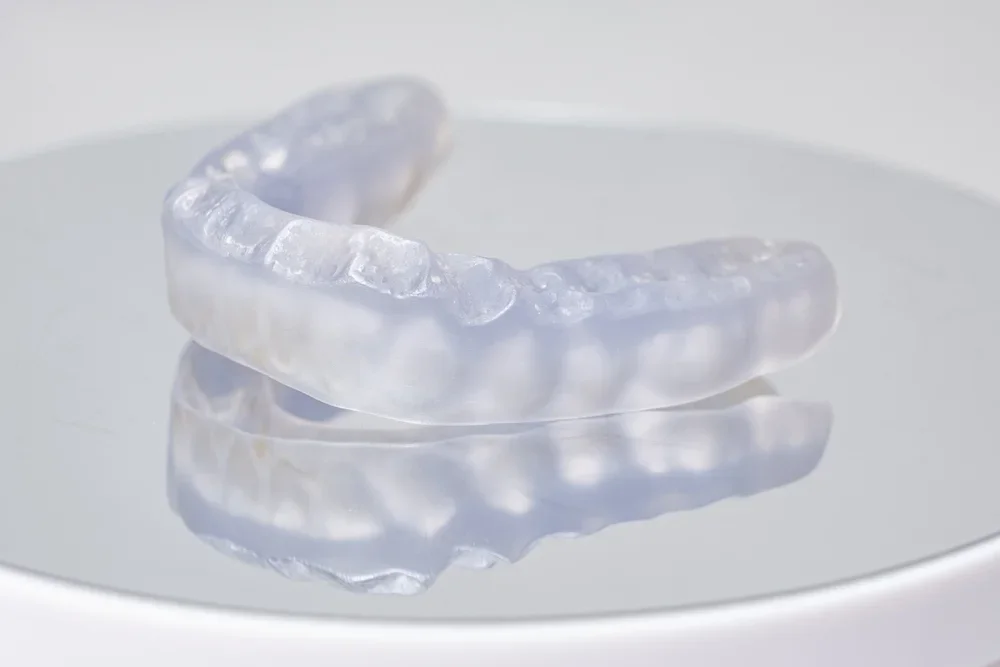
An oral appliance for sleep apnea is a custom-made mouthpiece, worn while you sleep, that holds your lower jaw slightly forward so your airway stays open. It is a recognized treatment for snoring and for mild to moderate obstructive sleep apnea, and an option for people who cannot tolerate a CPAP machine. Dentists do not diagnose sleep apnea; a physician does, usually with a sleep study. Once you have that diagnosis, we can make and fit the appliance.
This page explains what obstructive sleep apnea is, the signs that suggest you might have it, why the medical diagnosis has to come first, how the appliance works, who it suits, and what to expect from fitting, follow-up and cost.
If you already snore heavily or have been told you stop breathing in your sleep, please speak to your family physician. Untreated sleep apnea is linked to high blood pressure, heart disease, stroke and daytime accidents. It is a medical condition that deserves a medical diagnosis.
What is obstructive sleep apnea?
When you fall asleep, the muscles of the throat and tongue relax. In some people they relax so much that the soft tissue at the back of the throat sags and narrows or blocks the airway. Breathing stops for ten seconds or more, oxygen levels fall, and the brain briefly wakes you to reopen the airway, often with a gasp or snort you do not remember. This can happen dozens of times an hour, all night, every night.
That is obstructive sleep apnea (OSA). Snoring is the sound of air squeezing past a partly narrowed airway. Many people who snore do not have apnea, but most people with apnea snore.
What are the signs I might have it?
- Loud, regular snoring, especially if a partner has noticed pauses in your breathing followed by gasps
- Waking unrefreshed, or with a dry mouth or headache
- Feeling sleepy during the day, dozing off while reading, watching television or driving
- Difficulty concentrating, irritability or low mood
- Waking often to use the bathroom
- High blood pressure that is hard to control
- Worn, flattened or cracked teeth from grinding, which often goes with sleep apnea
We sometimes notice the dental signs, such as tooth wear, a large tongue, a narrow airway or a scalloped tongue edge, during a routine check-up. When we do, we will suggest you see your physician.
Why does a physician's diagnosis and sleep study come first?
Because sleep apnea is a medical condition, and only a physician can diagnose it. In Ontario, a sleep study (polysomnography, done overnight in a sleep laboratory, or in some cases with a home monitor) records your breathing, oxygen level, heart rate and sleep stages. It measures how many times an hour your breathing stops or becomes shallow, which is how mild, moderate and severe apnea are defined.
That number decides the right treatment. For severe apnea, CPAP (continuous positive airway pressure, a mask that gently blows air to keep the airway open) is the standard of care. For mild to moderate apnea, or for people who cannot use CPAP, an oral appliance is an accepted alternative recommended by the Canadian Thoracic Society and the American Academy of Sleep Medicine. Making an appliance without a diagnosis could leave serious apnea untreated while the snoring seems to improve.
So the sequence is: your physician, a sleep study, a diagnosis and a prescription or referral for oral appliance therapy. Then we take over the dental part.
How does a mandibular advancement device work?
A mandibular advancement device (MAD) is the most common type of oral appliance. It is two thin custom trays, one over the upper teeth and one over the lower, connected so that the lower jaw is held a few millimetres forward of its resting position. Moving the jaw forward pulls the tongue and soft tissue forward with it, which widens the airway behind the tongue.
The amount of forward movement is adjustable. We start with a comfortable position and advance it in small steps over several weeks until snoring and symptoms improve. Because the appliance is made from a digital scan of your teeth in our own lab, it is slim, fits precisely and stays in place.
Who is it for, and who needs CPAP instead?
A good fit for
Adults with a physician diagnosis of mild to moderate obstructive sleep apnea; people with severe apnea who have tried CPAP and cannot tolerate it; people with snoring alone, once apnea has been ruled out; and people who travel often and want a small, silent alternative.
Usually not suitable
People with too few sound teeth to hold the appliance (implants can sometimes solve this); active gum disease or loose teeth; severe jaw-joint problems; or a full upper and lower denture. Children and teenagers are assessed differently.
CPAP remains the right choice for
Severe sleep apnea, very low overnight oxygen levels, or when the appliance has been tried and the follow-up sleep study shows it is not controlling the apnea. An appliance can also be used alongside CPAP to allow a lower pressure.
What happens at fitting and follow-up?
- Assessment. We review your sleep study and physician's report, examine your teeth, gums and jaw joints, and take a digital scan.
- Fitting. About two weeks later the appliance is fitted and adjusted, and you are shown how to insert, remove and clean it.
- Adjustment. Over four to eight weeks the jaw position is advanced a little at a time until symptoms improve without discomfort.
- Confirmation. Your physician may order a follow-up sleep study with the appliance in place to confirm it is working. Feeling better is not the same as being treated.
- Yearly review. We check the fit, your teeth and bite once a year, and replace the appliance when it wears out, typically after three to five years.
What are the side effects?
Most side effects are mild and settle within a few weeks: extra saliva or a dry mouth, tender teeth in the morning, and stiffness in the jaw muscles or joint on waking. We give you a simple morning exercise that returns the jaw to its normal position.
Over years of nightly wear, a small change in the bite can occur as the lower teeth move slightly forward. It is usually minor and most people do not notice it, but it is real, which is one reason for the yearly review. If you have jaw-joint problems, read our page on jaw pain and TMJ and tell us before we begin.
What does it cost, and is it covered?
A custom appliance, including the fitting visits and adjustment period, typically costs between about $2,000 and $4,000 in Ontario. The fee reflects the custom laboratory work and the several months of adjustment visits, not just the device. Fees vary; we provide a written estimate before treatment.
OHIP does not cover oral appliances. Because sleep apnea is a medical condition, many extended health plans cover part of the cost under medical rather than dental benefits when there is a physician's diagnosis and prescription. We will give you the documentation your insurer needs. Learn about our financing options if you would like to spread the cost.
Common questions
Can you test me for sleep apnea?+
No. A dentist cannot diagnose sleep apnea. We can recognize the signs and refer you to your physician, who can arrange a sleep study. Once you have a diagnosis, we make and fit the appliance.
Will an oral appliance stop my snoring?+
For most people with simple snoring or mild to moderate apnea, yes, or it reduces it greatly. Results depend on your anatomy and on wearing it every night. Your partner is often the first to report the difference.
Is it as good as CPAP?+
CPAP is more powerful at stopping breathing pauses, especially in severe apnea. Oral appliances are used more consistently because they are easier to live with, so in mild to moderate cases the real-world results are often similar. Your physician will advise which suits your diagnosis.
Can I use a boil-and-bite anti-snoring device from a pharmacy?+
We do not recommend it. Store-bought devices are bulky, move during the night, are not adjustable and can shift your teeth unpredictably. More importantly, using one without a diagnosis can hide serious apnea. A custom appliance is thinner, adjustable and fitted under supervision.
How long does an appliance last?+
Usually three to five years with nightly wear, depending on the material and on whether you grind your teeth. We check it each year and let you know when it is time for a new one.
Sources: Fleetham J, Ayas N, Bradley D, et al. Canadian Thoracic Society 2011 guideline update: diagnosis and treatment of sleep disordered breathing. Can Respir J 2011;18(1):25–47 · Ramar K, et al. Clinical practice guideline for the treatment of obstructive sleep apnea and snoring with oral appliance therapy: an update for 2015. J Clin Sleep Med 2015;11(7):773–827
Have a sleep apnea diagnosis, or worried about snoring?
Bring your sleep study and we will tell you whether an appliance is right for you. If you have not been tested yet, we will help you take that first step. Call (905) 479-7777.