Bone Grafting for Full Mouth Implants: Building a Lasting Foundation
Being told you need a bone graft before implants lands badly. It sounds like an extra operation to make an operation possible, and people often hear it as bad news about their chances.
Being told you need a bone graft before implants lands badly. It sounds like an extra operation to make an operation possible, and people often hear it as bad news about their chances.
In practice it is routine, it is usually smaller than it sounds, and modern full-arch planning avoids it more often than it used to. Here is what it actually involves.
The short version
- Bone is lost after teeth are removed because nothing is stimulating it any more.
- There are several quite different procedures under the one word "graft".
- Some grafting happens at the same appointment as implant placement; some needs months first.
- Tilting implants — the basis of All-on-4 — often avoids grafting entirely.
- Whether you need it is a question the scan answers, not a matter of opinion.
Why bone disappears
Jawbone exists to hold teeth. It is maintained by the forces transmitted through them every time you bite.
Remove a tooth and that stimulation stops. The bone around the socket resorbs — fastest in the first months, continuing more slowly for years. The ridge gets narrower and shorter.
The practical consequences: someone who lost teeth two years ago usually has more workable bone than someone who lost them fifteen years ago. Long-term denture wearers often have the least, because a denture presses on the ridge without stimulating it. And the back of the upper jaw loses bone particularly readily, with the sinus expanding downward into the space.
None of this means implants are impossible. It means the plan has to account for what is there.
The different procedures
"Bone graft" covers several procedures with very different scales.
Socket preservation
Graft material placed into a socket at the moment a tooth is removed, to limit the shrinkage that would otherwise follow. Adds minutes to the extraction appointment and is by far the least involved.
If you are having teeth out now and implants later, ask about this. It is much easier to preserve bone than to rebuild it.
Ridge augmentation
Building width or height back onto a ridge that has already narrowed. Graft material is placed and covered with a membrane, and the site is left to heal for several months before implants go in.
This is the one that adds real time to a treatment plan — commonly four to nine months depending on how much is needed.
Sinus lift
For the back of the upper jaw, where the sinus floor has dropped. The sinus membrane is gently lifted and graft material placed beneath it, creating height for an implant.
A small lift is often done at the same appointment as implant placement. A larger one is done first, with several months of healing before implants.
It sounds alarming and is generally well tolerated. The commonest after-effects are mild congestion and the instruction not to blow your nose forcefully for a couple of weeks.
Block grafting
A piece of bone secured to the deficient area, usually taken from elsewhere in your own jaw. Reserved for substantial defects and the most involved of the options. Uncommon in routine full-arch planning.
What the material is
Four sources, in decreasing order of how much people worry about them and increasing order of how often they are used.
Your own bone, taken from another site. Integrates most predictably; requires a second surgical site.
Processed human donor bone, from regulated tissue banks and sterilised. Widely used, with a long safety record.
Processed animal bone, usually bovine. Acts as a scaffold that your own bone grows into over time.
Synthetic material, typically calcium-based ceramics. No donor involved at all.
Most grafting uses processed donor or synthetic material, often mixed. None of them stay as foreign material indefinitely — they act as a framework that your own bone replaces. If the source matters to you for personal or religious reasons, say so; there are options and we will use them.
How grafting is often avoided
This is where full-arch planning has genuinely changed.
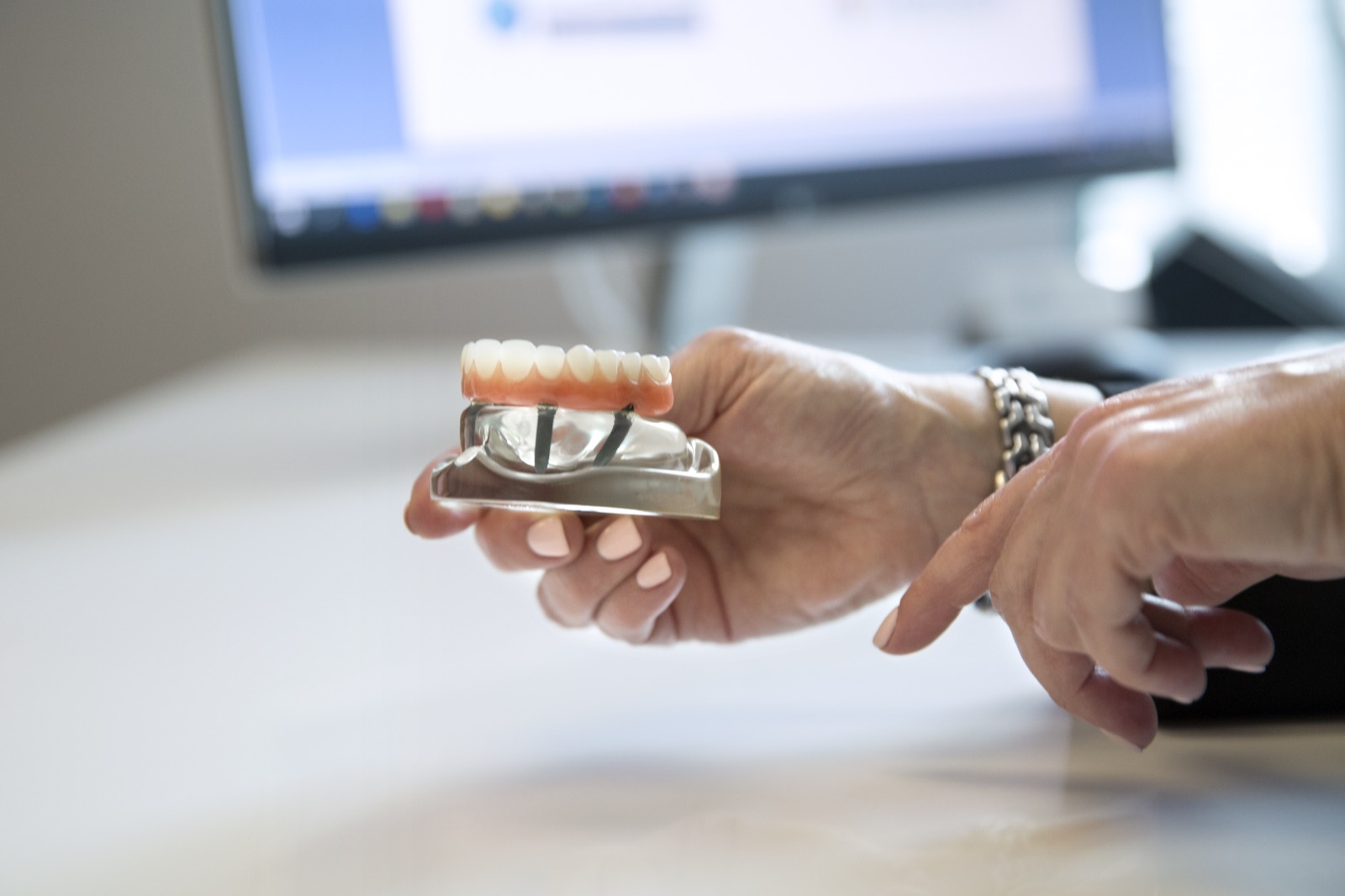
The old approach placed implants vertically where teeth used to be, which in a resorbed jaw meant grafting first. Tilted-implant techniques — the basis of All-on-4 — angle the rear implants forward into the denser bone toward the front of the jaw, reaching past the sinus and nerve rather than building bone up to meet them.
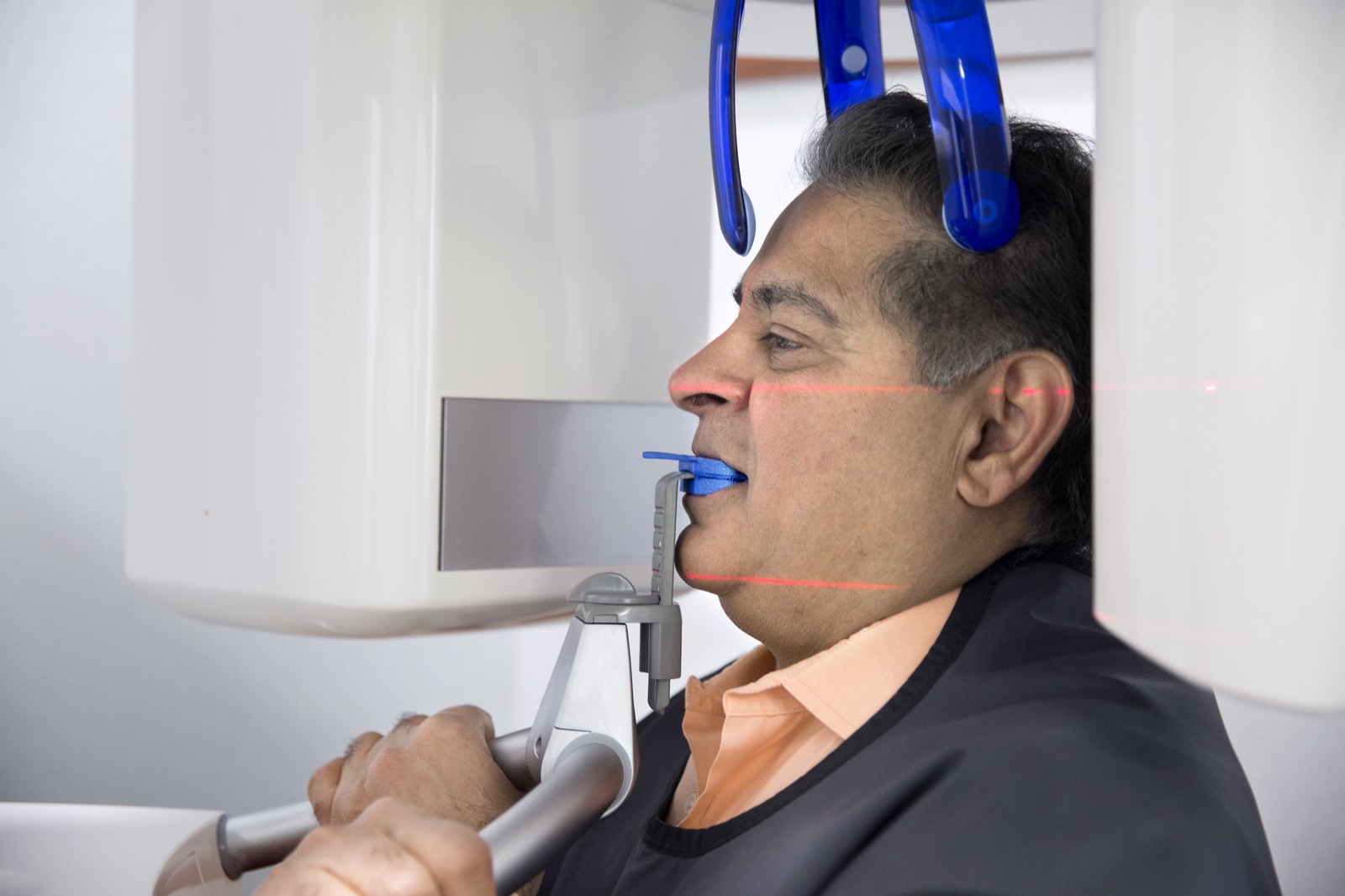
A CBCT scan is what makes this possible, because it shows exactly where usable bone remains. A flat X-ray does not. This is the practical reason a great many people who were told years ago that they needed extensive grafting can now be treated without it.
It does not work for everyone. Where the front of the jaw has also lost significant volume, grafting is still the honest answer.
What recovery is like
For socket preservation and small sinus lifts: much like an ordinary extraction. Swelling for a few days, soft food, over-the-counter painkillers.
For ridge augmentation and larger lifts: more swelling, sometimes bruising, a week of taking it easy. Soft food, no vigorous exercise for a week or so, and no smoking — grafts are particularly sensitive to it.
Then waiting, which is the harder part. Four to nine months for the graft to mature into bone that can hold an implant. Nothing is happening that you can feel.
What it does to the timeline
Graft at the same time as implants: no added delay. Common for small sinus lifts and minor defects.
Graft first, implants later: adds four to nine months before implant surgery, then the usual three to six months of integration after.
So a plan involving substantial grafting may run eighteen months from start to final teeth rather than six. You have teeth throughout — a temporary denture or bridge — but it is worth knowing at the outset rather than discovering at month four.
Cost
Grafting is quoted separately from the implant treatment, because not everyone needs it. It is one of the six factors that move a full-arch case within its $18,000 to $36,000 range, alongside implant count, bridge material, extractions, infection and sedation.
Socket preservation is modest. Ridge augmentation and large sinus lifts add meaningfully. Any quotation you are given before a scan cannot include it honestly, which is a reason to be cautious about prices quoted over the phone.
Finding out whether you need it
A CBCT scan answers this in one appointment — how much bone you have, where, and whether implants can be placed in it as it stands. Book a consultation and we will show you your own scan and tell you plainly.
Common questions
Is bone grafting painful?
You feel nothing during it. Afterwards, socket preservation is like an extraction; larger grafts mean more swelling for a few days, managed with ordinary painkillers.
Can grafts fail?
Occasionally, most often in smokers. If a graft does not take, it can usually be repeated. We check it has matured before placing implants.
Will my body reject it?
Graft material is processed to remove anything that would provoke a rejection response. It acts as a scaffold your own bone replaces.
How long before implants can go in?
Between nothing and nine months, depending entirely on which procedure. Ask specifically which one is planned for you.
Can I avoid it by having All-on-4?
Often, which is much of the point of tilted implants. Not always. The scan decides.
Do I have teeth while I wait?
Yes — a temporary denture or bridge throughout.
Is a sinus lift dangerous?
It is a well-established procedure. The most common issue is a small tear in the sinus membrane, which is usually repaired during the same appointment.
I was told years ago I had too little bone for implants. Has that changed?
Possibly. Tilted-implant techniques and 3D planning have altered what is possible for many people in that position. It is worth being reassessed with a scan.

Free Dental Implant Seminar — No Obligation, No Pressure
"Everything You Need to Know About Today's Dental Implant Treatments" — held monthly at our Markham clinic.
Explore Topics
Written by
Dentistry at Vitality Health
Content creator and writer sharing insights and stories.