Computer Guided All-on-4 Implants in Markham: The Precision Standard
An All-on-4 asks four implants to carry an entire jaw of teeth. That is a demanding thing to ask, and it is the reason guided placement matters more here than almost anywhere else in dentistry.
An All-on-4 asks four implants to carry an entire jaw of teeth. That is a demanding thing to ask, and it is the reason guided placement matters more here than almost anywhere else in dentistry.
With a single implant, being a degree or two off-angle is usually recoverable — the crown is adjusted and nobody notices. With four implants carrying one rigid bridge, the errors do not average out. They add up.
The short version
- All-on-4 places two implants upright at the front and two tilted backwards, to reach solid bone and avoid the sinus and nerve.
- Those tilted implants are difficult to place accurately by eye, which is exactly what a guide solves.
- Four implants supporting one bridge have to relate to each other correctly, not just individually.
- Tilting often avoids bone grafting that would otherwise be needed.
- Guided placement does not make everyone a candidate. Some jaws need six implants, and some need grafting first.
Why two of the implants are tilted
This is the idea the whole technique rests on, and it is worth understanding before anything else.
In the upper jaw, the sinus sits above the back teeth. In the lower jaw, a nerve runs through the bone beneath them. In both, the bone at the back tends to be the first to thin after teeth are lost. Placing an implant straight up at the back of either jaw often means not enough bone, or a graft, or a sinus lift.
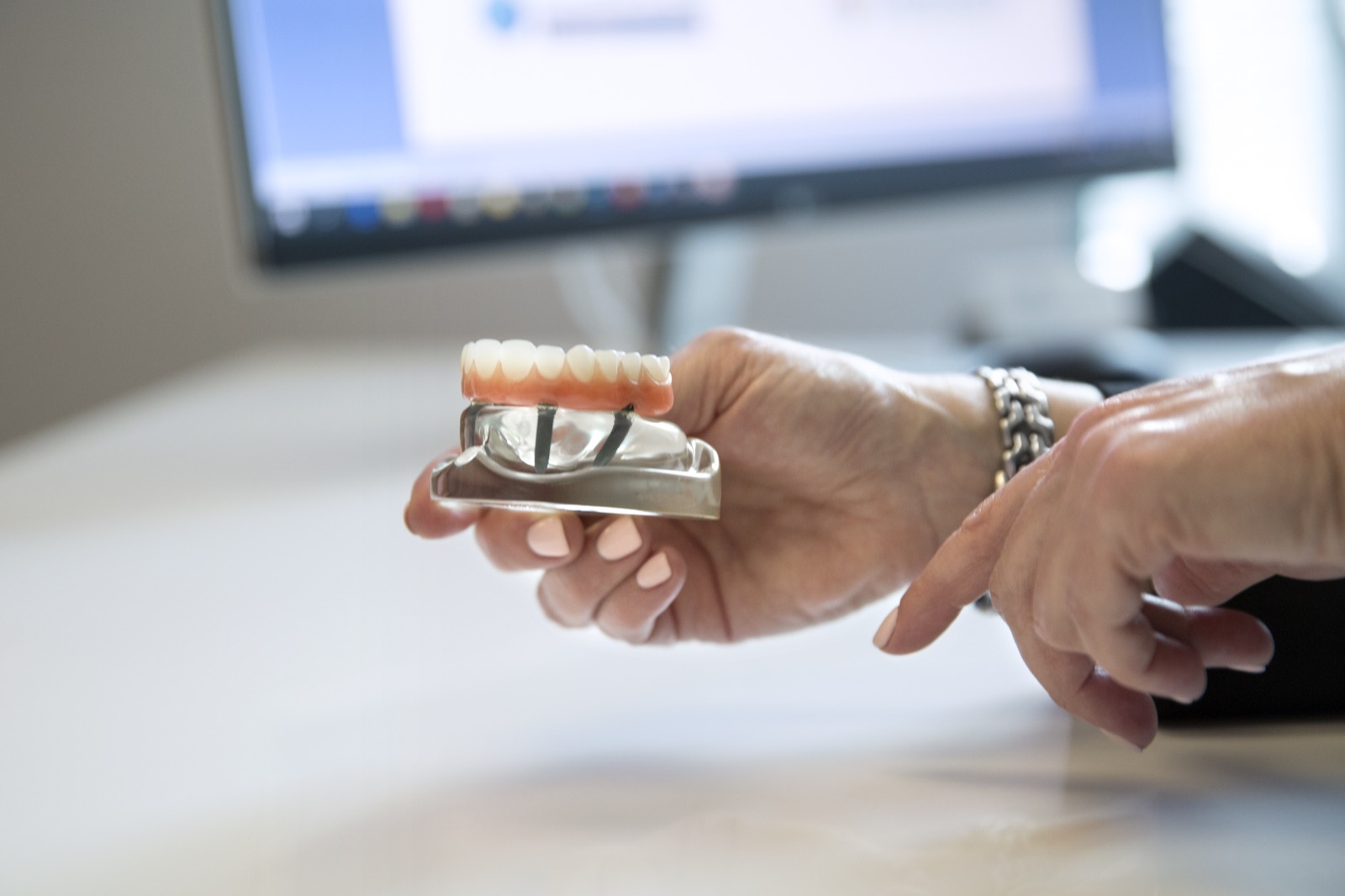
All-on-4 avoids this by angling the two rear implants forward at roughly thirty to forty-five degrees. The implant is set into the denser bone toward the front of the jaw, but because it is tilted, the point where it emerges sits further back — far enough to support a bridge with molars on it.
The effect is that the bridge is supported across a wide span while all four implants are anchored in bone that is actually there. For many people this removes the need for grafting entirely, which shortens the treatment by months.
Why this is hard to do freehand
Placing an implant straight down into visible bone is one thing. Placing one at a calculated angle, at a calculated depth, so that it clears the sinus wall by a defined margin and emerges exactly where the back of the bridge needs support — that is a different problem.
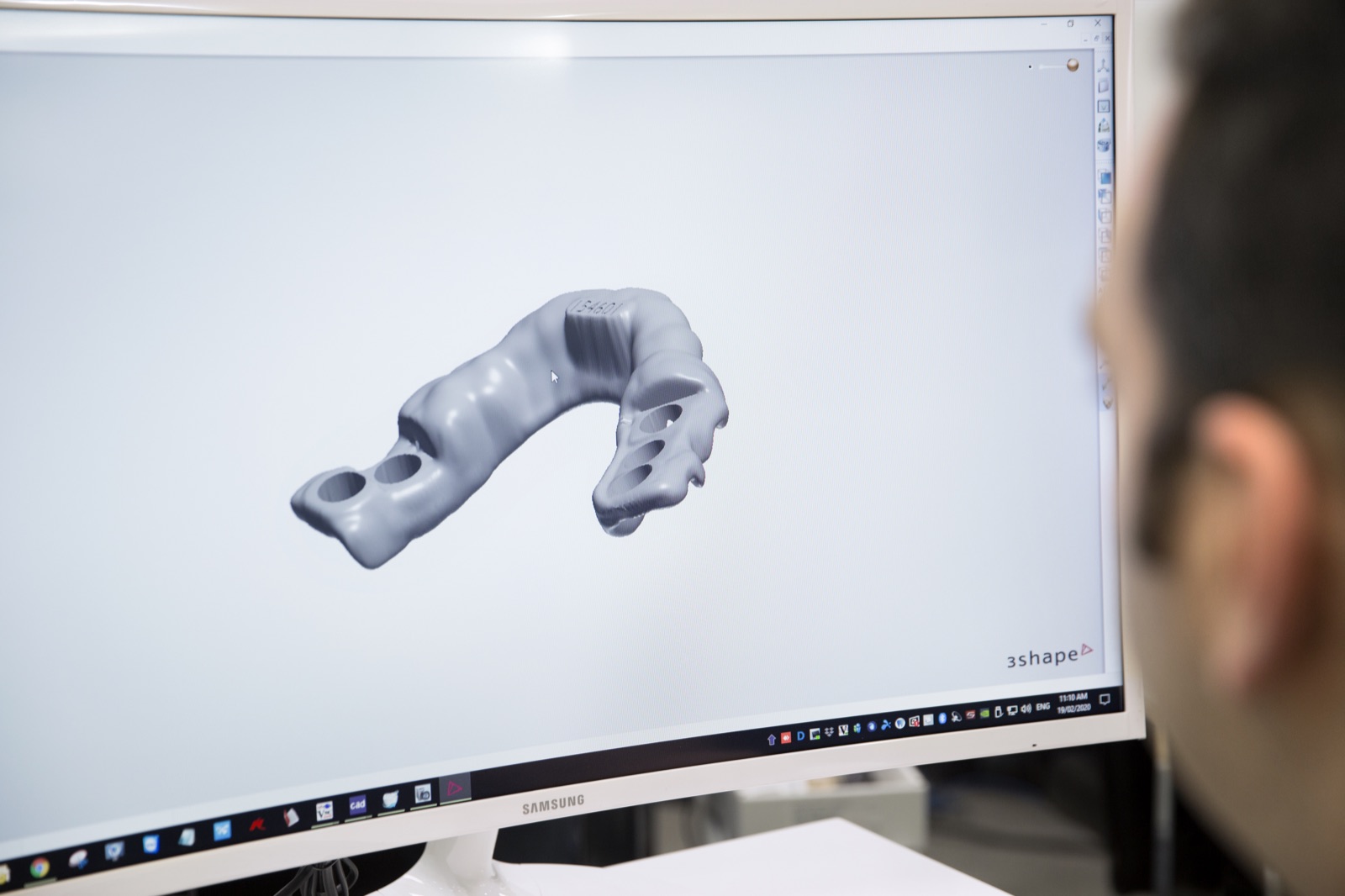
The surgeon cannot see the sinus floor or the nerve canal during surgery. They are inside bone. With a flat X-ray, their position is inferred. With a CBCT scan and planning software, it is known, and the implant can be positioned against it with a defined safety margin.
The guide then holds that angle. This is the practical difference: the angle was chosen deliberately, on a screen, with the anatomy visible from every direction, rather than judged in the moment.
The four have to agree with each other
There is a second problem that only appears in full-arch work.
A one-piece bridge has to seat on all four implants at once, passively — without being sprung or forced into place. If one implant is angled such that the bridge has to flex to reach it, that tension never goes away. It is carried permanently by the implants and by the bone around them.
Planning all four positions together, on one model, is how that is avoided. Each is checked against the others, not only against the bone. It is the reason a full arch benefits from guidance far more than a single tooth does.
What the treatment actually involves
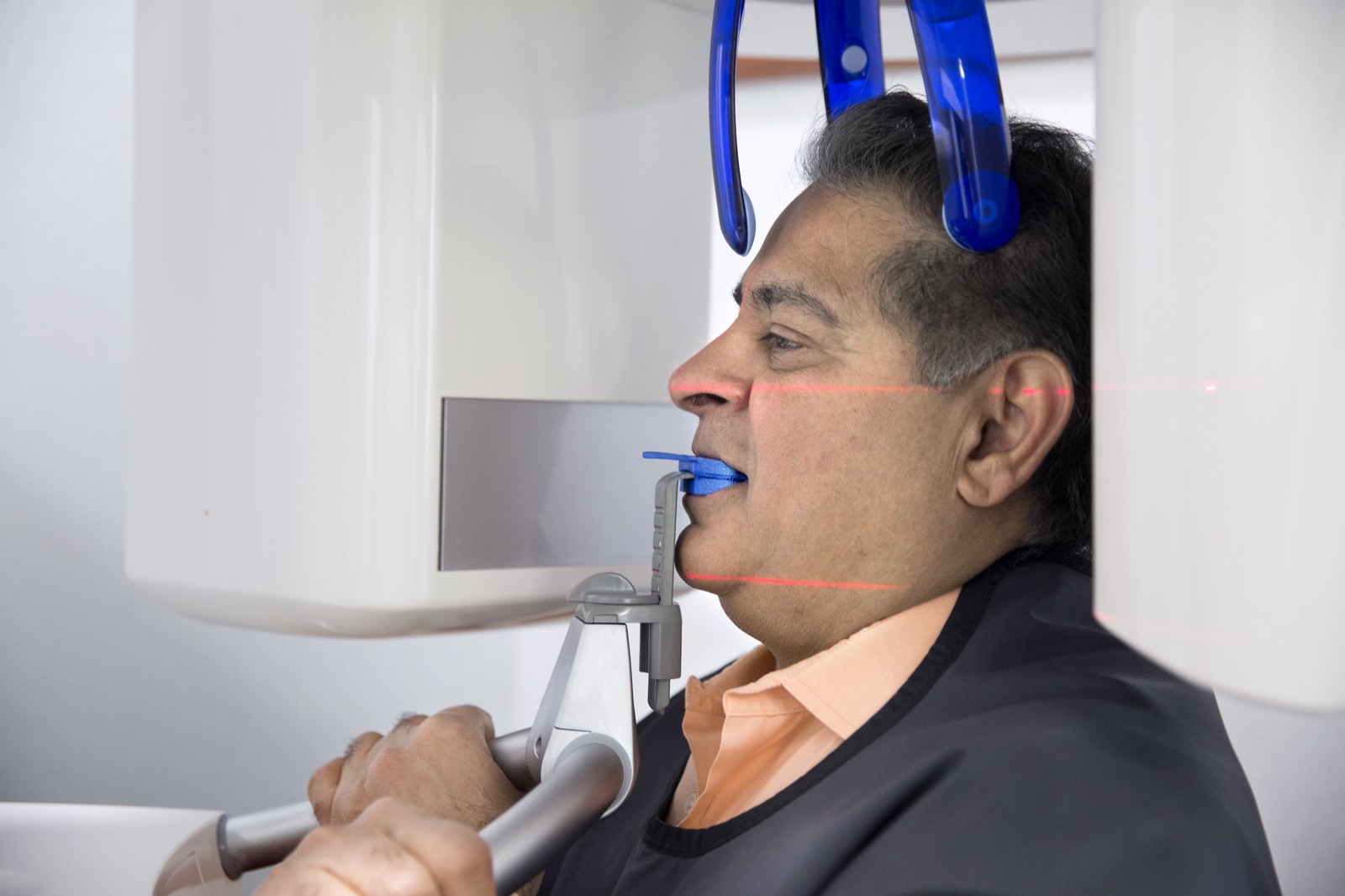
Consultation and scanning. A CBCT scan and a digital scan of your mouth. An examination of what is left — remaining teeth, gum health, any infection, how much bone there is at the front of the jaw where the implants will anchor.
Planning. The implants are positioned in software. This is also where we find out whether four is the right number for your jaw, or whether six would be better.
Plan review. You see your own scan on screen, with the plan on it. Ask about anything that is not clear.
Surgery. Remaining teeth removed, implants placed through the guide, temporary bridge fitted the same day. A few hours.
Two-week review. Stitches, bite check, adjustments.
Three to six months. Integration. Soft food throughout.
Final bridge. New impressions, a try-in where you approve the appearance, then the permanent bridge.
When four is not the right number
All-on-4 is a technique, not a default. Planning sometimes shows that it is not the right one.
Softer bone, a heavy bite, a history of grinding, or a plan for a zirconia bridge all argue for six implants rather than four — more anchor points, less load on each. Very severe bone loss at the front of the jaw may mean grafting before implants can be placed at all.
The honest position is that the scan tells us, and we tell you. A practice that proposes All-on-4 before looking at a scan is proposing a technique rather than a treatment.
Our piece comparing All-on-4 and All-on-6 goes through the trade-off in more detail.
Cost
A full arch in Markham runs from about $18,000 to $36,000 per jaw, spanning All-on-4 through All-on-6. What moves you within that range:
- Number of implants — four or six
- Bridge material — acrylic at the lower end, zirconia at the upper
- Bone grafting, if the scan shows it is needed
- Extractions — how many teeth have to come out first
- Infection — active infection has to be resolved before implants go in
- Sedation — local anaesthetic through to IV sedation
Guided planning, the CBCT scan, the guide, the surgery, the temporary bridge and the final bridge are all inside that figure. You should expect a written quotation that itemises them. If a quoted price seems unusually low, ask which of the six items above it excludes.
Finding out where you stand
Most of the questions people arrive with — is there enough bone, do I need grafting, is four enough, how long will it take — are answered by the scan rather than by a conversation. Book a consultation and we will look at yours together.
Common questions
Does tilting the implants weaken them?
No. A tilted implant set in dense bone is generally more stable than an upright one in thin bone, which is the alternative it replaces. The angle is accounted for in the bridge design.
Can I avoid bone grafting?
Often, which is much of the point of the technique. Not always — if the bone at the front of the jaw is also severely reduced, grafting may still be needed. The scan decides this.
How long does the surgery take?
For one arch, usually a few hours including extractions and fitting the temporary bridge. You are not aware of the time under sedation.
Do I leave with teeth?
Yes. A fixed temporary bridge goes on the same day. The permanent one comes months later, once the implants have integrated.
Is All-on-4 the same as a denture?
No. A denture rests on your gums and is removed. An All-on-4 bridge is screwed to implants in bone and stays in. Cleaning is done around and under it, in place.
What if one implant fails?
It is removed, the site heals, and it is replaced. With four implants this matters more than with six, which is part of the argument for six in higher-risk cases.
Can I have both jaws done?
Yes, often at the same surgery. It roughly doubles the cost and makes the soft-food period harder, since there is no unaffected side.
Does dental insurance cover it?
Most Ontario plans contribute something but few cover a full arch. Annual maximums are typically well below the treatment cost. We will help you submit a predetermination so you know the number before committing.

Free Dental Implant Seminar — No Obligation, No Pressure
"Everything You Need to Know About Today's Dental Implant Treatments" — held monthly at our Markham clinic.
Explore Topics
Written by
Dentistry at Vitality Health
Content creator and writer sharing insights and stories.