
Our Services
Children's dentistry
Gentle, unhurried care for children of every age, from the first tooth to the first set of braces. We have looked after Markham families since 1985, and we speak 12 languages.
Reviewed by Dr. Ray Han, General Dentist, Dentistry at Vitality Health
Your child should see a dentist within six months of their first tooth coming in, or by their first birthday, whichever comes first. That first visit is short and gentle. It lets us check that the teeth are coming in normally, show you how to clean them, and help your child feel at home in a dental office before anything ever needs fixing.
This page answers the questions parents ask us most: when to come in, why baby teeth matter, how much toothpaste to use, what fluoride and sealants do, and how we help nervous children. It also explains the two government programs that help with children's dental costs in Ontario.
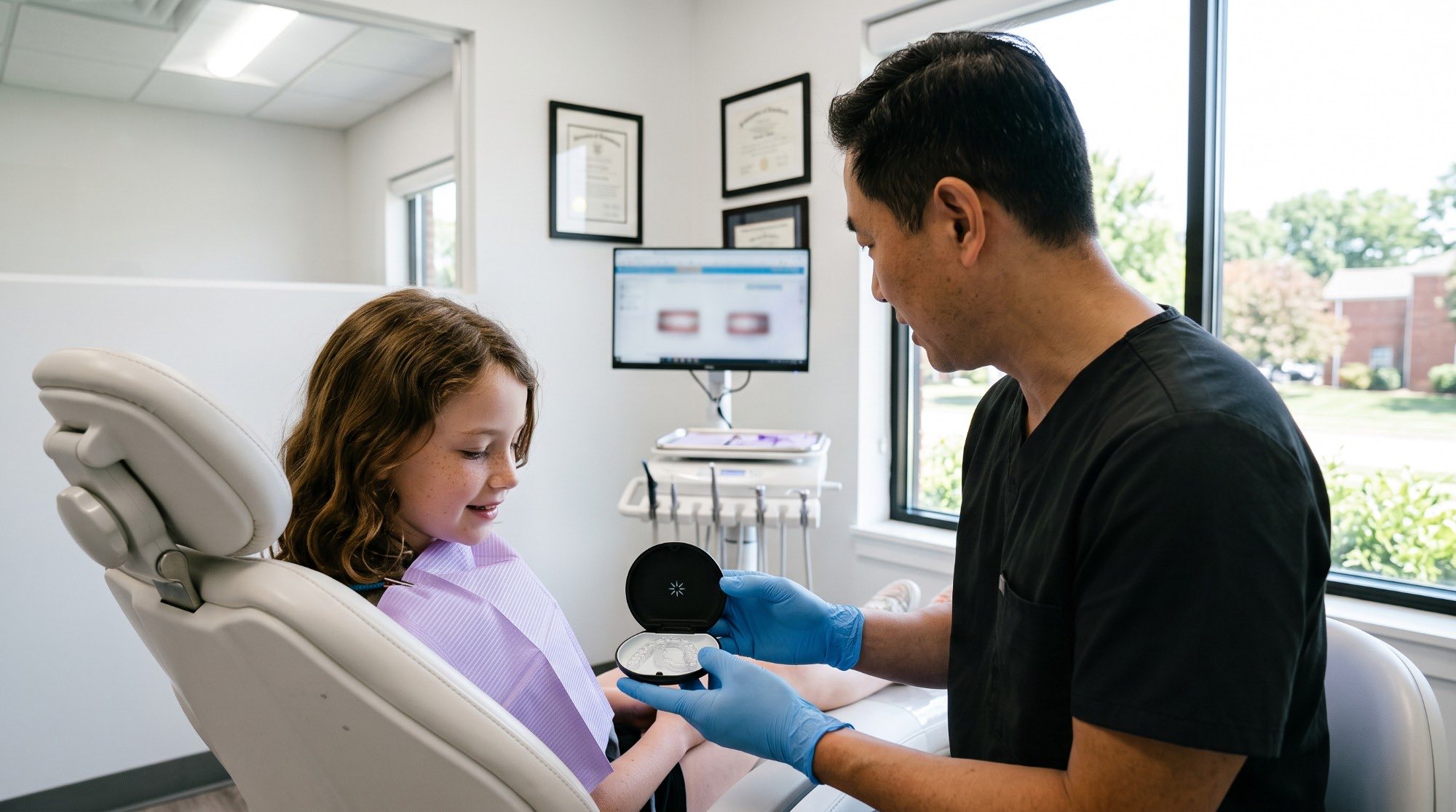
Children's care at our practice is provided by our general dentists and hygienists. If your child ever needs a paediatric dental specialist or an orthodontist, we will say so and help you get there. Orthodontic treatment here is provided by Dr. Julien Kim, our orthodontist.
When should my child first see a dentist?
The Canadian Dental Association recommends a first assessment within six months of the first tooth coming in, or by 12 months of age. Many parents are surprised by how early that is. The reason is simple: tooth decay can start as soon as teeth appear, and habits set in the first years, like bottles at bedtime, do most of the damage before age three.
An early first visit is also the easiest one. Nothing hurts, nothing is drilled, and your child learns that the dentist is a friendly place. Children who start early are far less likely to be anxious later.
What happens at a child's first appointment?
- A chat with you. We ask about feeding, teething, habits like thumb-sucking or soothers, and any family history of dental problems.
- A gentle look. For babies and toddlers this often happens on your lap, knee to knee with the dentist. We count the teeth, check the gums and look for early signs of decay.
- A cleaning demonstration. We show you how to brush a small child's teeth and how much toothpaste to use.
- Fluoride varnish, if it will help. A quick painted-on coating that strengthens enamel. It takes seconds.
- Questions answered. Bring a list. Nothing is too small.
For older children, the visit includes a proper cleaning and, when they can hold still for it, x-rays to check between the teeth. We only take x-rays when there is a reason to.
Why do baby teeth matter if they fall out anyway?
Baby teeth (also called primary teeth) do four jobs. They let your child chew properly and eat a healthy range of foods. They shape the way your child learns to speak. They hold the space for the adult teeth underneath and guide them into position. And they can become infected just like adult teeth, which hurts and can damage the adult tooth developing below.
A baby molar that is lost too early lets the neighbouring teeth drift into the gap, and the adult tooth may not have room to come in straight. That is why we treat cavities in baby teeth rather than waiting for them to fall out, and why we sometimes place a small space maintainer when a baby tooth is lost early.
When do baby teeth come in and fall out?
Every child is different, and a few months either way is normal. This is a typical pattern:
| Teeth | Usually come in | Usually fall out |
|---|---|---|
| Lower front teeth (central incisors) | 6 to 10 months | 6 to 7 years |
| Upper front teeth (central incisors) | 8 to 12 months | 6 to 7 years |
| Side front teeth (lateral incisors) | 9 to 16 months | 7 to 8 years |
| First molars | 13 to 19 months | 9 to 11 years |
| Canines (the pointed teeth) | 16 to 23 months | 9 to 12 years |
| Second molars | 23 to 33 months | 10 to 12 years |
The first adult molars come in behind the baby teeth at about age six, without any baby tooth falling out first. Parents often mistake them for baby teeth. They are adult teeth that will not be replaced, and they are the teeth most often protected with sealants.
How do I clean my baby's teeth, and how much toothpaste should I use?
Start before the first tooth. Wipe your baby's gums with a clean, damp cloth after feeds. Once teeth appear, switch to a small soft toothbrush and brush twice a day, especially at bedtime. Do not put your child to bed with a bottle of milk or juice; the sugar sits on the teeth all night.
The Canadian Dental Association's guidance on fluoride toothpaste by age:
- Under 3 years: brush with water only, unless your dentist says your child is at risk of cavities. Then use a portion of fluoride toothpaste the size of a grain of rice, with an adult doing the brushing.
- 3 to 6 years: use a portion the size of a green pea. An adult should brush or closely help, and teach your child to spit out the toothpaste rather than swallow it.
- Over 6 years: a pea-sized amount, with supervision until your child can brush well alone, usually around age 8.
Start flossing as soon as two teeth touch. Floss picks make this much easier with small children.
What does fluoride do, and what is fluorosis?
Fluoride is a mineral that makes tooth enamel harder and more resistant to the acids that cause cavities. It is in most toothpastes and in the drinking water in many Ontario communities, including Markham. In the office we can also paint on a fluoride varnish, which is a stronger dose that stays on the teeth for several hours.
Fluorosis is a change in the look of the enamel, usually faint white flecks or lines, that can happen if a young child swallows too much fluoride while the adult teeth are forming under the gums. Most fluorosis is mild and hard to see. The way to avoid it is simple: use the small toothpaste amounts above, keep toothpaste out of reach, and teach your child to spit. Fluoride used correctly is safe and prevents cavities. Health Canada and the Canadian Dental Association both support its use.
Prevention and protection
Dental sealants
A thin coating painted into the grooves of the back molars, where a toothbrush cannot reach the bottom. It seals out food and bacteria. Sealants are quick and comfortable to place, and usually last several years. We recommend them when the adult molars come in, at about ages 6 and 12.
Thumb-sucking and soothers
Both are normal in babies and toddlers. The Canadian Paediatric Society suggests giving up the soother by age 3 to 4 to avoid problems with the bite. A habit that continues past age 4 or 5 can push the front teeth forward. We can suggest gentle ways to help, and we will tell you if the bite needs attention.
Sports mouthguards
Any sport with a ball, a stick or contact calls for a mouthguard: hockey, soccer, basketball, martial arts. A custom-fitted guard made from a scan of your child's teeth fits far better than a boil-and-bite one and is more likely to stay in. We remake them as the mouth grows.
Why treat a cavity in a baby tooth?
Because it hurts, because it spreads, and because it can harm the adult tooth underneath. A small cavity in a baby tooth can reach the nerve in months, not years, because baby teeth have thin enamel. Once the nerve is infected, the tooth may need to come out early, with the spacing problems described above.
Caught early, a cavity in a baby tooth is a short, simple filling. Very small early spots can sometimes be stopped with fluoride alone. This is one more reason regular check-ups matter more for children than for adults. Read more about cavities and tooth decay.
How do you help a nervous child?
Most children do well with a calm explanation, a chance to see and touch the instruments, and a parent nearby. We use the “tell, show, do” approach: we tell your child what will happen, show them on a finger or a model, and then do it. We never surprise a child.
For children who are very anxious, or who need longer treatment, we offer nitrous oxide, often called laughing gas. It is breathed through a small nose mask, works within minutes, wears off within minutes of stopping, and your child stays awake and can talk to us the whole time. It has a long safety record in children. Read about laughing gas for children, or ask us before the visit.
A few tips that help: book a morning appointment when your child is rested, avoid words like “hurt” or “needle” beforehand, and let us do the explaining. Children take their cue from the adults around them.
Which government programs help with children's dental costs?
Healthy Smiles Ontario is the provincial program for children and youth 17 and under in lower-income households. It covers check-ups, cleanings, fluoride, sealants, fillings, extractions and emergency care at no cost to the family. Children in families receiving Ontario Works or the Ontario Disability Support Program qualify automatically; others apply based on household income. Apply at ontario.ca/healthysmiles or through York Region Public Health.
The Canadian Dental Care Plan (CDCP) is the federal program for families without dental insurance and with a family net income under $90,000. Children are covered. If a child qualifies for both programs, Healthy Smiles Ontario is used first. We accept both plans and can help you understand which applies. See our CDCP information page.
Common questions
How often should my child see the dentist?+
Every six months is the usual rhythm for children, because cavities in baby teeth develop quickly. Some children with a low risk of decay can come yearly, and some with a high risk should come more often. We will tell you which applies to your child.
My child is two and has never been to the dentist. Is that a problem?+
No. Just book a visit now. The first appointment is gentle and mostly about looking and showing. Nothing is done that your child is not ready for.
Are dental x-rays safe for children?+
Yes, when used only when needed. Our digital x-rays use a very low dose, and we shield your child with a lead apron and thyroid collar. We do not take x-rays on a fixed schedule; we take them when the dentist needs to see between the teeth or check a developing tooth.
What if my child knocks out a tooth?+
For a baby tooth, do not put it back in. Call us. For an adult tooth, pick it up by the white crown, rinse it briefly in milk or saline, put it back in the socket if you can, or keep it in milk, and get to us within an hour. Our knocked-out tooth guide explains each step.
When should my child see an orthodontist?+
The Canadian Association of Orthodontists suggests a first orthodontic check around age 7, when the adult front teeth and first molars are in. Most children do not need treatment then, but a few problems are easier to correct early. Dr. Julien Kim, our orthodontist, provides these assessments.
Do you see children with special needs?+
Yes. Tell us about your child when you book so we can plan extra time, a quieter slot, or a different approach. If we think a paediatric dental specialist would serve your child better, we will refer you.
Sources: Canadian Dental Association: position on first visit to the dentist · Canadian Dental Association: position on the use of fluorides in caries prevention · Canadian Paediatric Society, Caring for Kids: Pacifiers (soothers) · Government of Ontario: Healthy Smiles Ontario
Ready to book your child's visit?
Whether it is a first tooth or a first filling, we will take it at your child's pace. Call (905) 479-7777 or book online.