
Technology & Patient Resources
Full-arch implant case study
A rehabilitation from failing dentition to a fixed prosthesis using All-on-6 — documented stage by stage.
The clinical journey
Clinical assessment
The patient presented with multiple teeth affected by advanced periodontal disease and a deteriorating removable prosthesis. 3D imaging revealed moderate bone loss, particularly in the posterior regions.
Surgical planning
3D imaging enabled precise implant positioning and minimised risk, with the plan delivered through computer-guided surgery. Posterior bone loss determined where the six implants could safely go.
Same-day surgery and restoration
Six implants placed under IV sedation over approximately two and a half hours, with a temporary prosthesis attached immediately — the patient was discharged with fixed teeth the same day.
Osseointegration
Five months of healing while functioning on the temporary prosthesis, with follow-up imaging confirming stable integration across all six implants.
Final prosthesis
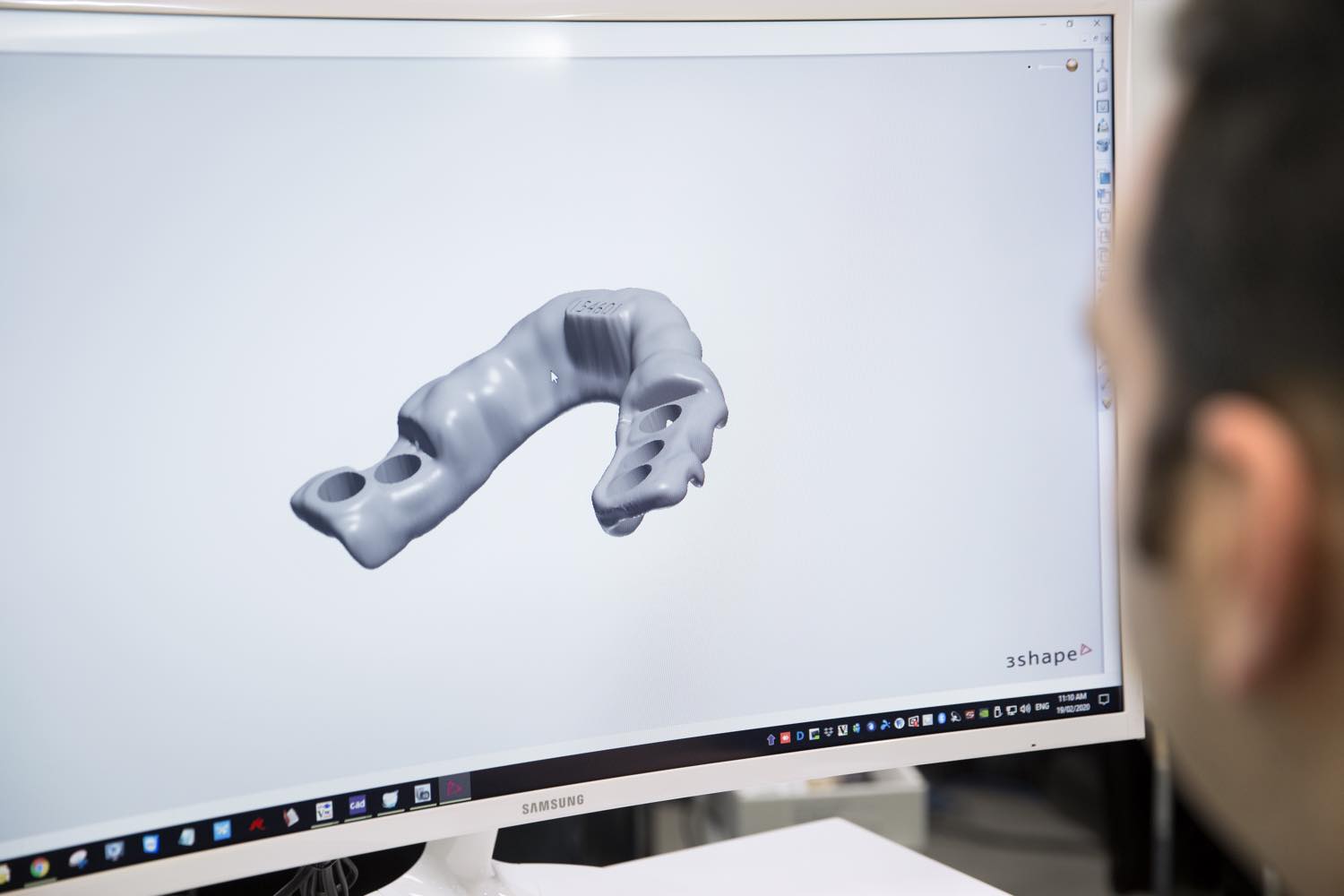
The definitive restoration designed and fabricated in our in-house digital lab, then fitted and refined for bite and appearance.
Why All-on-6 rather than All-on-4 here
Bone loss was moderate rather than severe, which meant six implant positions were achievable. Where six can be placed safely, they distribute load more evenly and build in a larger safety margin — losing one of six costs 17 percent of support against 25 percent with four.
Had the posterior bone loss been more advanced, All-on-4's angled placement would likely have been the better answer, and we would have planned it that way.
Why six implants rather than four
This is the decision most worth understanding, because it is where full-arch planning is actually done.
- Four implants can carry a full arch when the bone at the front of the jaw is good and the implants can be angled to spread the load — All-on-4.
- Six spreads the load further back, which matters when the bone behind is compromised, or when the bite forces are heavy. It also means losing one implant is less likely to compromise the whole bridge — All-on-6.
- Six costs more and involves more surgery. It is not a better option in the abstract; it is the right option where the bone and the bite call for it — All-on-4 compared with All-on-6.
In this case posterior bone loss decided it. The available bone behind the jaw determined where implants could safely go, and six positions gave a distribution four could not.
Why it is staged rather than done in one go
A full arch is not one appointment, and the waiting is doing something.
- Assessment and planning. A 3D scan and an intraoral scan, merged, so implant positions are decided against both the bone and the teeth that will sit on them — in-house 3D CBCT scanning.
- Surgery, with a fixed temporary bridge. You do not leave without teeth. The temporary is deliberately not the final one — it is lighter, and it is meant to be adjusted.
- Healing, three to six months. The implants integrate with the bone. This cannot be hurried, and it is the reason the timeline is what it is.
- The final bridge. Made once the tissues have settled and the temporary has shown how the bite behaves in real use.
The temporary stage is not a delay tactic. It is a test. How you chew, speak and clean with the temporary informs what the final bridge should be — full-arch implants sets out the whole sequence.
What this case does not tell you
One case is one case. Bone volume, gum health, bite forces, general health and habits all differ, and they are what decide the plan and the outcome.
What is transferable from it is the reasoning: that the number and position of implants follows the bone available, that the staging exists for biological reasons rather than administrative ones, and that the temporary phase is part of the treatment. What is not transferable is the result.
Any assessment starts with imaging and an examination, and you get a written, itemised estimate before anything begins — implant costs and financing.
Common questions
Why six implants instead of four?+
Because the bone behind the jaw was compromised. Six positions spread the load further back than four could here. Six is not better in the abstract; it costs more and involves more surgery, and it is the right choice where the bone and the bite call for it.
Will I leave without teeth?+
No. A fixed temporary bridge goes on at the surgical appointment. It is deliberately not the final bridge, because it is meant to be adjusted while things settle.
Why does it take months?+
The implants have to integrate with the bone, which takes three to six months and cannot be hurried. The temporary phase also shows how the bite behaves in real use, which informs the final bridge.
Will my case go the same way?+
Not necessarily. Bone volume, gum health, bite forces and general health all differ and all affect the plan. What transfers from a case like this is the reasoning, not the result.
What does a full arch cost?+
It depends on the number of implants and the bridge material. You get a written, itemised estimate before treatment begins, and financing is available if the cost needs spreading.
Have a question?
Book a consultation to discuss full-arch options. Call (905) 479-7777.